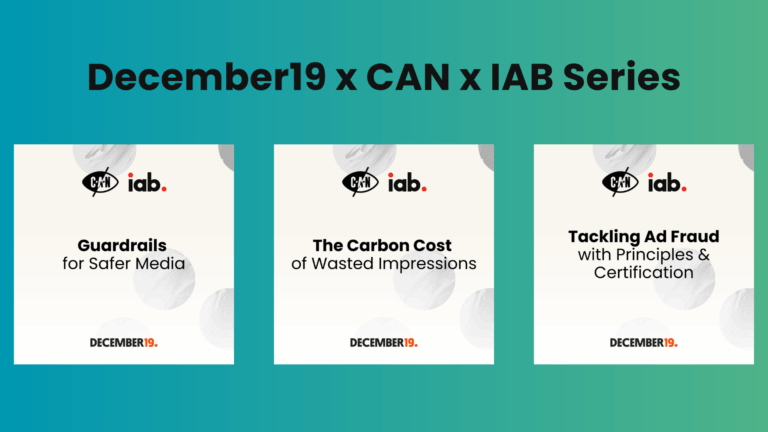
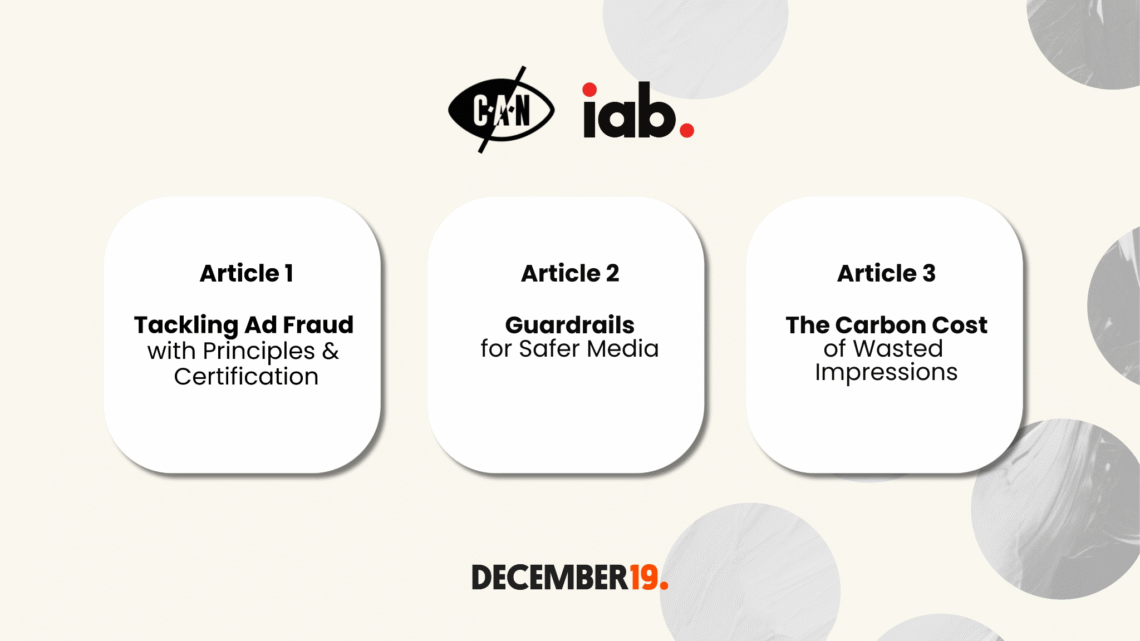
Advertisers have a responsibility not only to deliver results but to protect trust, promote sustainability, and ensure the integrity of the media ecosystem. That’s why CAN has partnered with December19 and digital advertising industry body IAB UK to produce a three-part series that translates ethical principles into actionable advertising practices.

We’re excited to introduce this series, designed to help advertisers reduce waste, safeguard investments, and contribute to an ecosystem where effective advertising works for everyone.

Why now?

Ad fraud, wasted impressions, and unsafe media environments cost the advertising industry billions each year, and the effects extend far beyond budgets:

  • Ad fraud funds harmful content and criminal activity.
  • Wasted impressions drive unnecessary carbon emissions at a time when climate-conscious media planning is critical.
  • Unsafe media placements erode consumer trust and brand reputation.

CAN research shows that conscious approaches to advertising, focusing on transparency, sustainability, and information integrity, deliver measurable benefits for brands, consumers, and society. This series demonstrates how to put these principles into practice.

Part 1: Exposing the Hidden Cost of Ad Fraud

Ad fraud is more than a financial drain; it’s a societal issue. Part 1 pairs CAN’s Anti Ad-Fraud Guide with December19’s operational experience in achieving IAB Gold Standard certification, exploring:

  • Where ad fraud hides and why it persists
  • Operational changes that combat fraud in real-world campaigns
  • How CAN’s principles strengthen the Gold Standard framework
  • Five essential questions every advertiser should ask
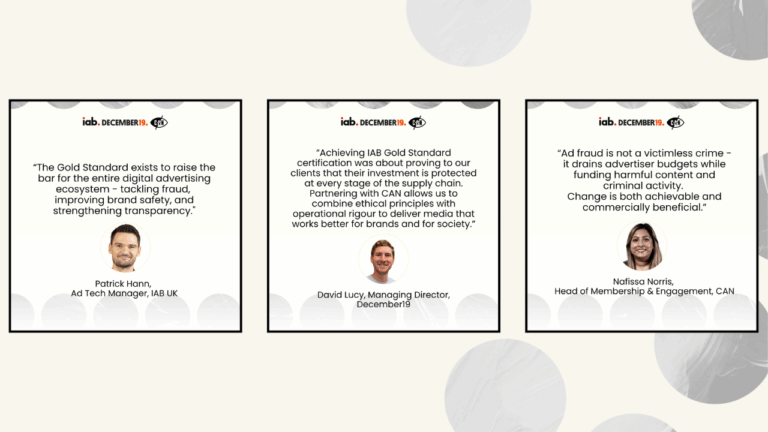
Part 2: The Carbon Cost of Wasted Impressions

Scale without purpose is wasteful, and waste carries a hidden carbon cost. Part 2 shows how advertisers can cut emissions while boosting performance, drawing on CAN’s Sustainability Guide and December19’s sustainability journey. Highlights include:

  • How wasted impressions inflate environmental impact
  • Operational shifts, including RefSettings adoption, Better Ads-aligned creative standards, and low-carbon campaign successes
  • How CAN’s Sustainability Guide reinforces IAB Gold Standard accountability
  • Four conscious questions every advertiser should ask
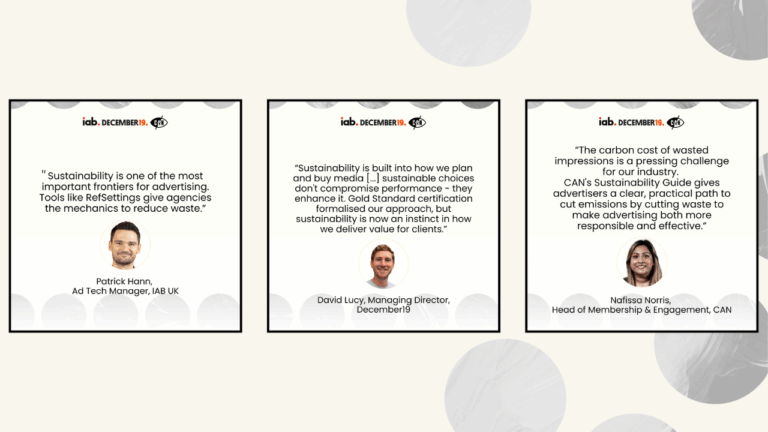
Part 3: Guardrails for Safer Media: Building Trust Through Integrity

Ads appear in environments that shape public perception. Unsafe or low-quality placements damage trust and engagement. Part 3 combines CAN’s Information Integrity & Hate Guide with December19’s Gold Standard experience to explore:

  • Operational guardrails: policies, staff training, tech adoption, and monitoring
  • How CAN’s Guiding Principles reinforce Gold Standard ethics in practice
  • Questions every advertiser should ask to protect brand and audience trust
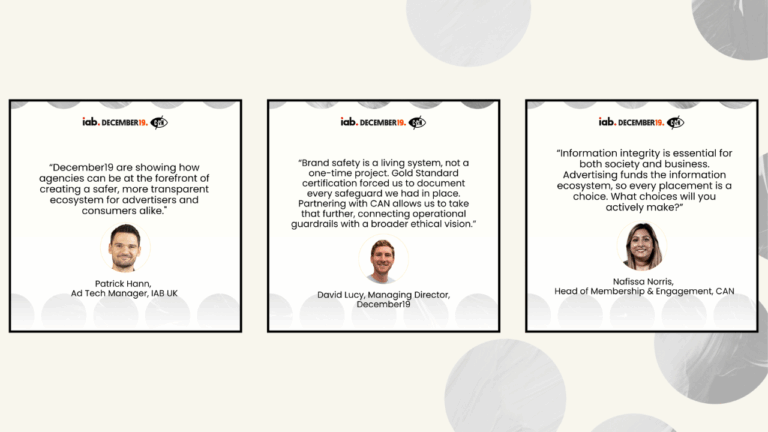
Thank you to December19 and IAB UK

Thank you to Josh Hood, David Lucy, Patrick Hann and the wider teams at December19 and IAB UK for sharing their expertise and opening up their operational journey with CAN.

This three-part series shows how conscious advertising can be commercially powerful, proving that cutting fraud, reducing waste, and protecting information integrity doesn’t just protect people and the planet, it also delivers better outcomes for brands.

If you’re looking to embed transparency, sustainability and trust into your media plans, explore CAN’s Guiding Principles and Guides to see how your organisation can start putting responsible advertising into practice. Please direct any questions or interest in CAN’s free membership to hello@consciousadnetwork.org.
As the final scene of 2025 rolls, we at CAN are hitting “pause” to reflect on a year of purposeful, ethical, and globally impactful advertising.

Advertising should inspire, innovate, and drive real results – but never at the expense of rights, freedoms, or societal trust. With a network of now over 200 members, we’ve challenged outdated norms, tackled waste and fraud, safeguarded society and the environment, and championed supply chain transparency.

This year has been a full feature of milestones, collaborations, and industry-leading impact, unlocking new opportunities for growth while ensuring effective advertising truly works for everyone.

Scene 1: Launching CAN Guiding Principles + Guides

Cue the opening credits: CAN rolled out six practical Guides alongside the CAN Guiding Principles, providing advertisers with actionable, ethical, and commercial results-driven steps. From inclusion to greenwashing, transparency to net zero, these resources make conscious advertising accessible, accountable, and measurable.

Scene 2: Annual Member Survey

Our Annual Member Survey captured what matters most to our community. Each year, our members share feedback on what’s working, what could improve, and where CAN should focus next.

This year’s key takeaways include:

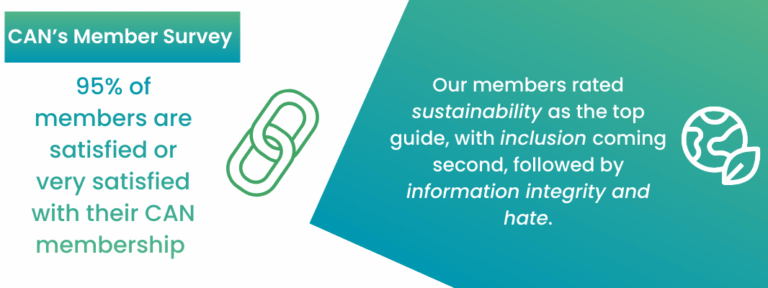
  • 95% of members are satisfied or very satisfied with their CAN membership, and 87% would recommend us to others in their network. This shows that our combination of advocacy, resources, and industry insight is making an impact.
  • Guides and resources on Sustainability, Inclusion, and Information Integrity & Hate are among the most valued tools, helping you reach diverse audiences, build trust, and prevent campaigns from funding misinformation or harmful content.
  • Implementation challenges include limited capacity and internal challenges in applying the Guides consistently across all brand teams and agencies. To address this, we are developing new toolkits, templates, and case studies that make it easier for members to embed CAN’s Guiding Principles into their work.
Expanding the CAN Team (1)
Scene 3: Expanding the CAN Cast

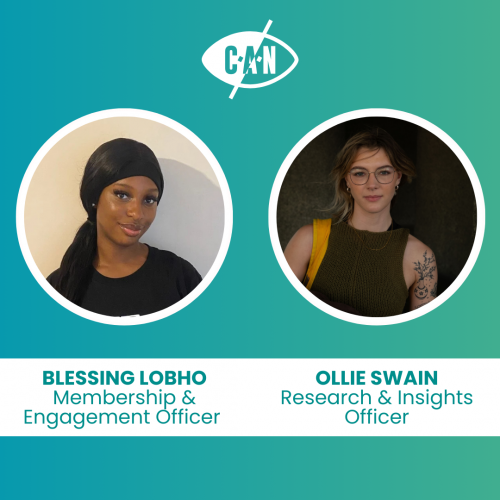
This year, we welcomed Blessing Lobho (Membership & Engagement Officer) and Ollie Swain (Research & Insights Officer), strengthening our capacity to support members, lead initiatives, and tackle pressing industry challenges from fraud and waste to climate and information integrity. Think of them as new leads in a blockbuster ensemble, bringing fresh energy and expertise.

You can learn more about Blessing, Ollie, and the rest of the CAN team HERE.

Scene 4: CAN on the Global Stage

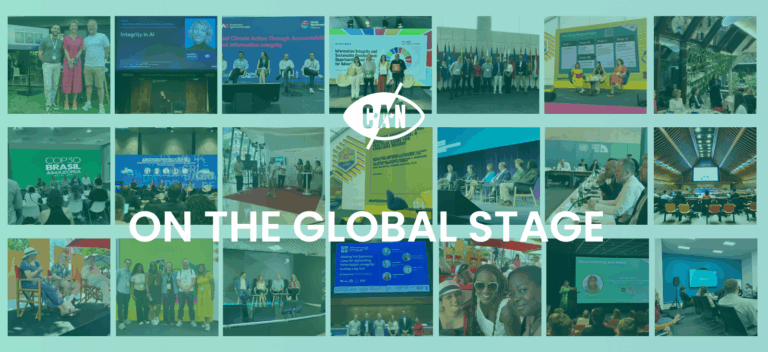
The CAN team were live on set at global industry events, here’s a glimpse:

  • Cannes Lions: Returning to Le Croisette, the CAN team returned stronger, sparking global conversations, and appearing on the official programme for the first time. Read more in CAN at Cannes Unpacked!
  • MAD//Fest: Panel alongside VCCP & TfL focussing on “Effective Advertising That Works for Everyone: A Practical Guide for Conscious Brands”, featuring TfL’s Abuse Has Consequence campaign as a case study on implementing CAN’s Guiding Principles. Read about the campaign HERE.
  • SMRS “All In” Day: exploring influencer marketing and consumer well-being, through the lens of CAN’s Guiding Principles and Guides.
  • EACA’s x 5Rights #Creative4Change: CAN were at the Strasbourg launch, reaffirming CAN’s ongoing contribution to building a digital ecosystem where children’s rights are protected by design. Find out more about Campaign 4 Good HERE.
  • AOP’s CRUNCH: CAN opened AOP’s CRUNCH session on “Investing in the future: how wider perspectives lead to inclusive narratives and engaged audiences”. Read the write-up HERE.
  • ERA26: CAN were on the agenda of Ebiquity’s exclusive annual event focused on Effective and Responsible Advertising in 2026. Check out the replay on Integrity in AI HERE.

CAN members also appeared in roundtables and panels across the UK, Europe, and Asia-Pacific, covering disability inclusion, children’s rights, climate, and information integrity. Each appearance was a close-up on actionable, conscious, and inclusive practices in the industry.

Scene 5: Spotlight on new Members & December19 Collaboration

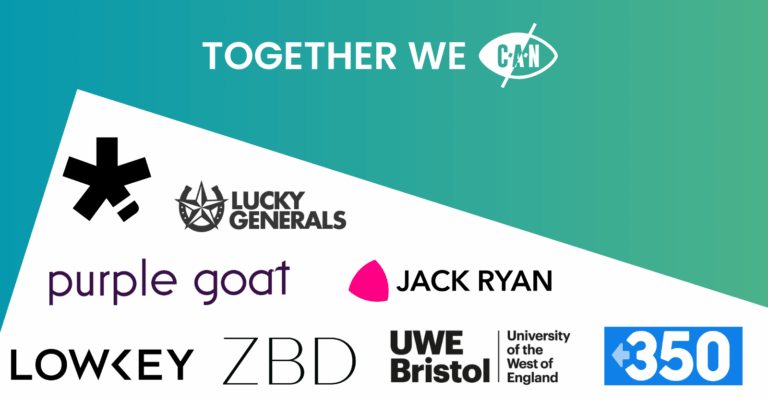
This year we welcomed JACK RYAN, Lucky Generals, UWE Bristol, 350.org, Purple Goat, Do Epic Good, ZBD and Lowkey Films to CAN’s membership.

Through Member Spotlights on LinkedIn, we celebrated campaigns effectively reshaping the industry.

Special feature: Following their IAB Gold Standard certification, CAN member December19 teamed up with us on a joint “CAN Principles + Certification” series. The certification required documenting practices in areas such as fraud prevention, brand safety, and supply chain transparency, revealing strong alignment with CAN’s Guiding Principles and Guides.

Together, we explored:

Certification provides operational guardrails; CAN provides the ethical compass – creating safer environments for brands and people.

Behind the scenes, this collaboration shows how ethical guidance paired with robust standards can unlock advertising that is effective, accountable, and designed to benefit everyone. At the end of each webpage (see links above), you’ll also find a downloadable, accessible two-page infographic to help teams put the key actions into practice.

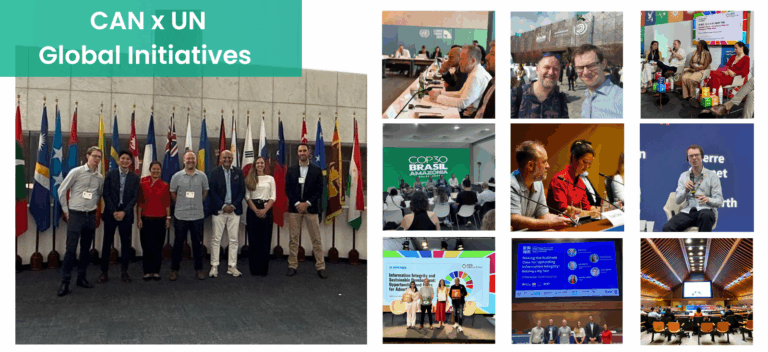
Scene 6: CAN x UN & Global Initiatives

Our UN collaboration strengthened this year through a global tour of joint speaking appearances promoting advertising’s vital role in climate information integrity and the UN’s Five Global Principles, where we served as key advisors. Engagements included:

  • Co-hosting a Bangkok roundtable with OHCHR on advertising, business, and human rights.
  • Participation in global panels ahead of COP30, such as:
      • Climate Information Integrity Summit: Check out the replay HERE
      • New York Climate Week: Check out the replay HERE
      • Internet Governance Forum (IGF Norway): Check out the replay HERE
  • COP30: Cementing climate information integrity as a core topic of discussion at COP30, marked by the launch of the Declaration on Information Integrity on Climate Change. Check out our COP30 wrap blog HERE

Each event was a critical scene, positioning CAN as a global advocate for responsible, impactful advertising.

Scene 7: Research & Advocacy Highlights

Our advocacy extended to UK Parliamentary Select Committee sessions, No.10 Downing Street roundtables, and other government engagements addressing online safety and social cohesion, our equivalent of cameo appearances that set new industry standards.

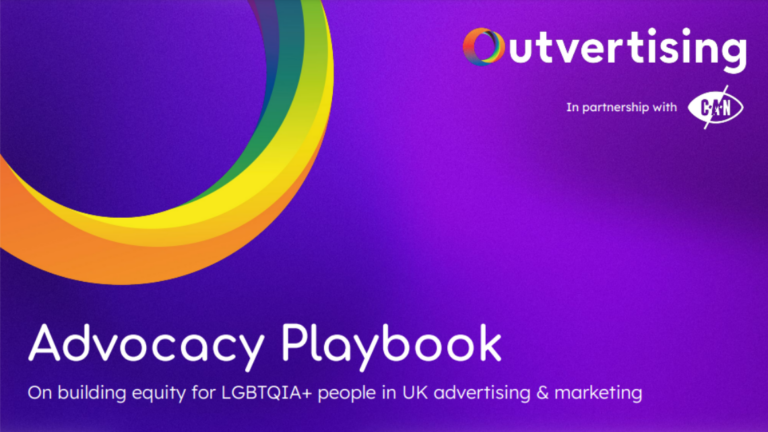
CAN is proud to have partnered with Outvertising to create the Advocacy Playbook, which is a practical, actionable guide designed to help advertisers build genuine LGBTQIA+ inclusion from the inside out. Bringing together data, principles and step-by-step guidance, it equips organisations to support their teams, strengthen their policies, and deliver more representative, inclusive campaigns.

Our Research & Insights work also focussed on topics such as protecting children from online harms, and the importance of protecting information integrity during extreme weather events.

Scene 8: CAN in the Media & Socials

Our LinkedIn and social media community grew to 5,000 followers, sharing insights, case studies, and updates. Our expanding blogs and explainer series have covered topics such as inclusion, transparency, targeted advertising, net zero, and UN principles, providing the behind-the-scenes director’s cut for conscious advertisers.

Final Scene: That’s a Wrap

Thank you to all the individuals and organisations who have continued to support us, including our fabulously supportive pro bono PR partners, Propeller Group! We wish you all a happy holiday season and a consciously creative new year.

#TogetherWeCAN

Information Integrity at COP30

COP30, which took place in Belem, Brazil, was described by President Lula as the “COP of truth”. Proving this point, for the first time in COP history, information integrity has formally been included on the UNFCCC Action Agenda.

There were two dedicated thematic days focusing on Information Integrity at COP30 – November 12th and 13th. These days were critical for highlighting the erosion of Information Integrity – which ultimately derails effective climate action – and for discussing the concrete actions needed to tackle the issue. At COP, CAN highlighted how advertising can and must play a vital role in improving the future of climate Information Integrity.

“Getting ‘information integrity’ onto the COP agenda in a year where ‘COP of Truth’ was one of the rallying messages is a genuine watershed moment and a victory that should be celebrated. The formal recognition that our information environment is a critical space for tackling the climate crisis is an important step, but we have a great deal of work to do. We’re excited to continue to work as part of a network of organisations from climate experts, academics, non-profit organisations and the advertising community, demonstrating that this is an issue that needs urgent attention”

Alex Murray, CAN’s Head of Advocacy

COP, and Information Integrity, is crucial for advertisers. The UN Global Principles for Information Integrity, released in 2024, outlines in part how advertisers and tech companies can adopt business models that simultaneously uphold human rights and strengthen information integrity, while also making good business sense.

In September 2025, the ‘From Principles to Practice’ document – a practical companion document to the UNGPII – was released, which outlines tangible steps for organisations, including advertisers, to begin implementing the UNGPII into their operations.

The Declaration on Information Integrity on Climate Change

On Wednesday November 12th, the Declaration on Information Integrity on Climate Change was launched at COP30. In the words of Charlotte Scaddan, (senior advisor on information integrity to the UN Global Communications), this is a “breakthrough moment” – marking the first time any states have formally committed to fighting climate disinformation. Austria, Portugal, Iceland, Norway, Czech Republic, Luxemburg, Slovenia and Estonia have also signed on to the Declaration since launch, joining Brazil, Canada, Chile, Denmark, Finland, France, Germany, Spain, Sweden, Uruguay, Netherlands, and Belgium – a total of 20 states. The Declaration comes out of the Global Initative for Information Integrity on Climate Change.

These States have committed to promoting the integrity of information related to climate change, supporting a diverse and resilient media ecosystem, and strengthening international cooperation to promote information integrity on climate change.

They also call on the private sector to:

  • Commit to the integrity of information on climate change in their business practices, in line with the United Nations Guiding Principles on Business and Human Rights.
  • Ensure transparent, human rights-responsible advertising practices that bolster information integrity on climate change and support reliable information and journalism.

“In endorsing this Declaration, we reaffirm our shared responsibility to ensure that societies around the world are empowered with the knowledge and information they need to act urgently and decisively in the face of the climate crisis,the Declaration concludes.

Speaking on the Declaration and the importance of addressing information integrity, António Guterres (Secretary-General of the United Nations) said:

“I welcome the stand taken by the 13 countries that have signed the Declaration on Information Integrity on Climate Change, which marks first time information integrity has been prioritized in international climate talks. I urge other countries to join this effort and to cement information integrity into COP processes. We cannot achieve climate action without information integrity. We must preserve both the information environment necessary for democratic decision-making and the global cooperation essential for addressing the climate crisis.”

CAAD Open Letter

Climate Action Against Disinformation (CAAD) released an open letter calling on all national government delegations to champion a strong, ambitious, and mandatory decision at COP30 to uphold information integrity on climate change. Over 400 climate leaders, organisations, academics, scientists, and doctors signed the call for action. Their message was clear: this is the time for robust, binding measures that protect public health, democracy and the planet’s future. You can watch the press conference of the launch of the open letter here, to hear the powerful message behind the call to action.

CAN at COP30

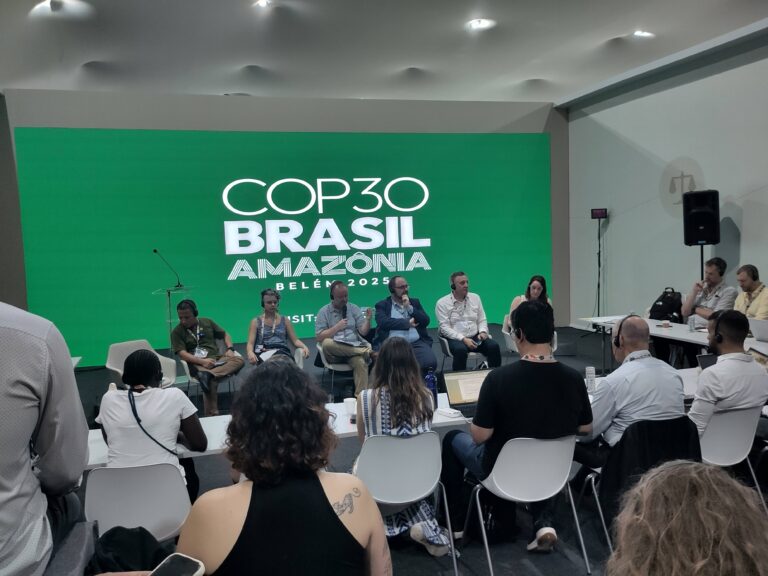
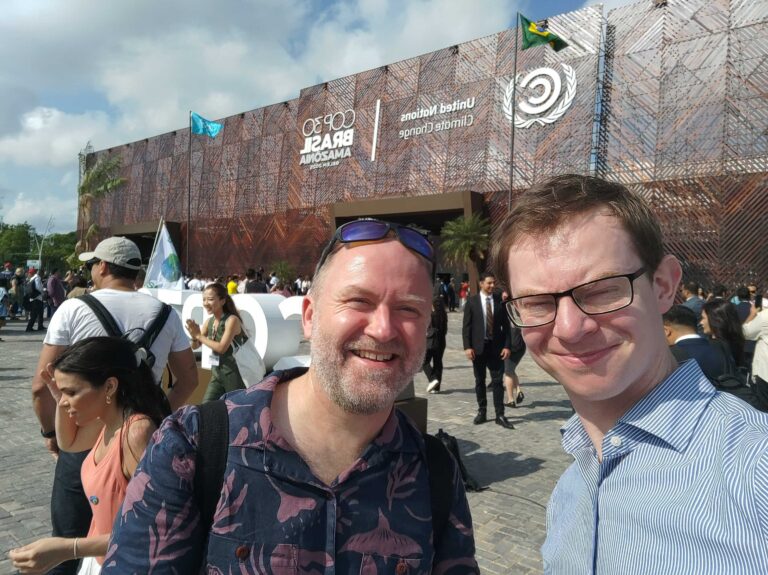
CAN Co-Founder Jake Dubbins and CAN Head of Advocacy Alex Murray were on the ground in Belém during the first week of COP30, making it their mission to highlight how advertising can and must play a vital role in improving the future of climate information integrity.

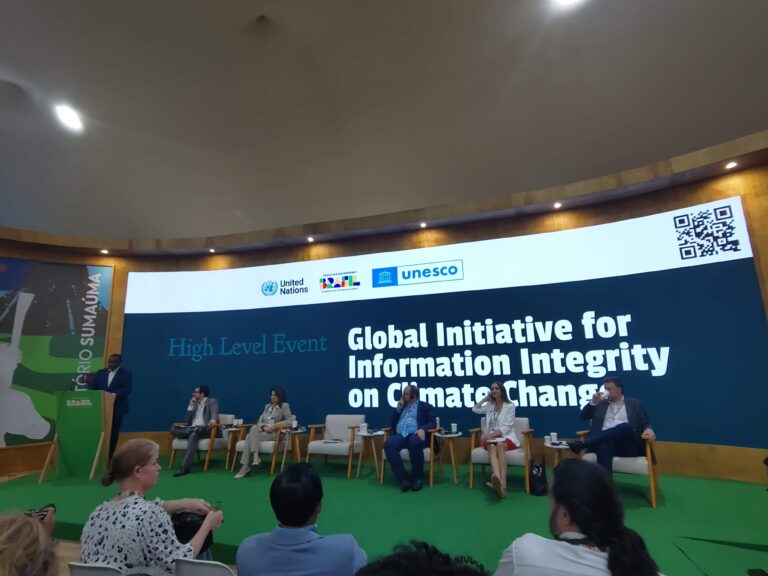
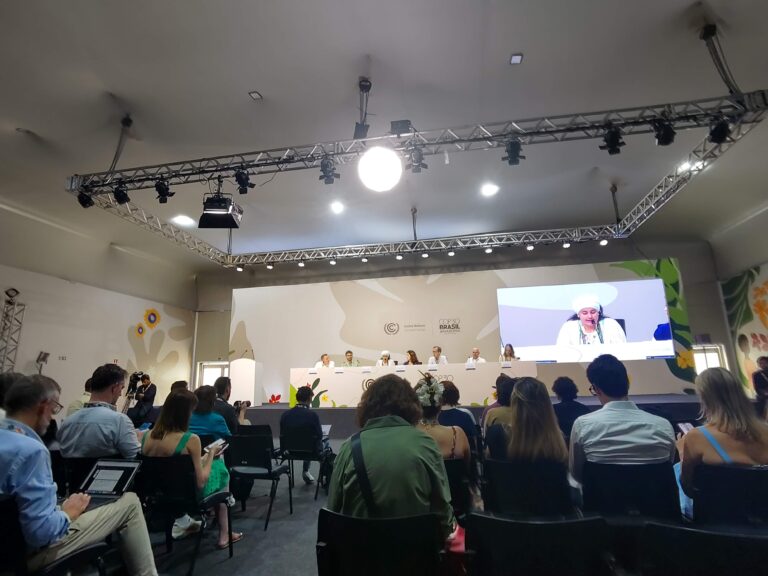
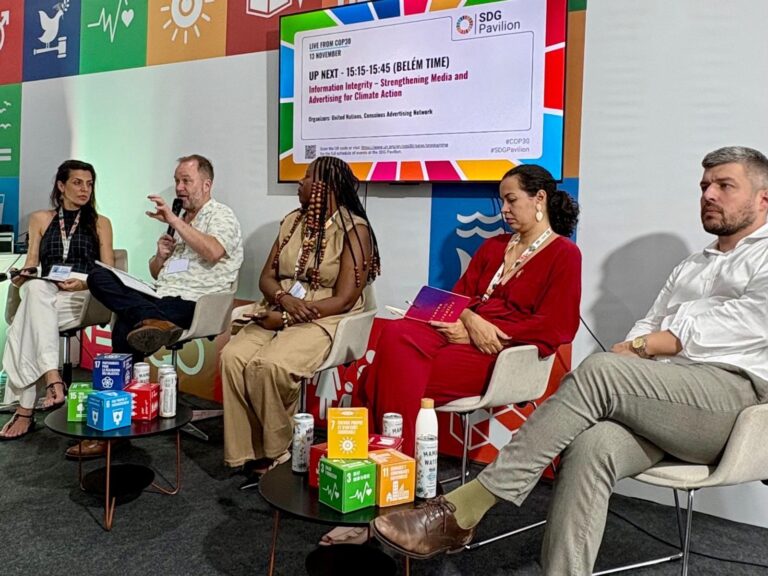
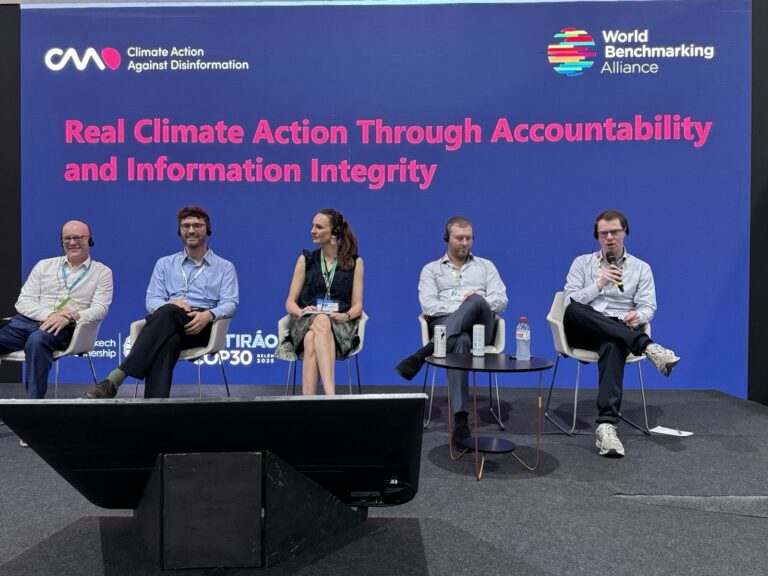
Alex hosted a panel as part of the UN Climate Action Agenda looking at Real Climate Action Through Accountability and Information Integrity, featuring voices from the World Benchmarking Alliance, C40 Cities, ACT Climate Labs, and the Global Wind Energy Council. Jake spoke at the Plan to Accelerate Solutions (PAS) Implementation Workshop focusing on the Promotion of Climate Information Integrity, as well as at a session looking at Information Integrity – Strengthening Media and Advertising for Climate Action.

Reflecting on the first week of COP30, Alex shared:

“This week has demonstrated that governments, the private sector, non-governmental organisations, multilateral institutions can work together to create plans to strengthen information integrity. Across this week we have heard from everyone from the COP Presidency to scientists, to mayors, businesses and frontline climate defenders that this is a critical issue for climate action. We are proud to have played our part in these initiatives and to ensure information integrity is a prominent issue at COP30 and going forward”

Final Thoughts

The end of COP30 saw information integrity directly mentioned in the final Global Mutirão text, marking a recognition of the need to protect the integrity of climate information on a global scale. These two weeks of COP30 have represented a culmination of the hard work of many organisations that have worked tirelessly to get information integrity included on the UNFCCC action agenda. While successful, this is just the start of another journey where we need to ensure states and organisations uphold their commitments to protecting climate information integrity.

COP30 has finished, but there are actions you can take year-round:

  • Use the CAAD definition to guide you when considering the content you want your advertising to be featured next to or when auditing inventory to establish approval or block lists.
  • If you are meeting contacts within tech platforms, ask them about their plans regarding climate Information Integrity and how they are tackling the problem.
  • Refer to CAN’s Sustainability Guide for guidance on how to support the information integrity of climate content, and on promoting positive climate messages in advertising.
  • Review the recommendations for advertisers within the United Nations Global Principles for Information Integrity (see pages 27-28).

This was a significant year at COP30, and we look forward to attending COP31 next year in Turkey to continue our commitment to upholding climate information integrity. In the meantime, CAN continues to advocate for sustainable advertising. To find out more, read our Guiding Principles here.

CAN co-founder, Harriet Kingaby sits down with Georgina Bramall, Director of Marketing Strategy at giffgaff to talk about the Up To Good Fund, a partnership between giffgaff, MG OMD and Ecologi that’s turning advertising spend into real-world climate and nature impact. In this conversation, we explore how the fund works, what impact it’s already making, and how other organisations can adopt similar models to embed sustainability into everyday marketing practice. As we outline in our Sustainability Guide, the advertising industry has the power to ensure that the content we create, the media we place, and the organisations and processes which govern them are sustainable. The Up To Good Fund is an example of taking concrete steps towards this goal.

Read on to find out how small, conscious actions in your marketing and media plans can add up to big change, and how your organisation can get involved.


Harriet: What made you want to launch the Up To Good Fund with MG OMD and Ecologi?

Georgina: We launched the Up To Good Fund because we want to use every lever in our business to support decarbonisation – and media is a big one. As a B Corp, we’re committed to Net Zero by 2040 and guided by our Responsible Marketing Manifesto, which means we already think carefully about our impact.

The Up to Good Fund helps to ensure that we make every campaign regenerative – every pound we spend in paid media gives something back to nature.

Partnering with MG OMD and Ecologi felt like the natural next step. We wanted to turn intent into action, to build something that could fund real nature recovery here in the UK while still driving great campaign performance. By collaborating across agencies, media owners, and sustainability experts, we’ve shown that marketing can be part of the solution – helping restore the natural environment that we all depend on.

Harriet: Can you walk us through how the Up To Good Fund actually works day to day?

Georgina: The Up To Good Fund is a really simple idea: a small percentage of all of our brand media spend goes directly into restoring nature here in the UK. So every advert, every placement, does a bit of good for the planet.

We set it up with our agency, MG OMD, and sustainability partner, Ecologi, and it’s supported by Ad Net Zero. Each media owner that’s part of our ecosystem contributes a small percentage (between 0.1 – 0.4%) of campaign-related spend into the Fund. This collective pot then funds and supports high-impact nature recovery projects – from peatland restoration and tree planting to wetland and meadow regeneration.

Harriet: What kinds of climate or nature projects has the fund helped support so far?

Georgina: We chose to work with Ecologi because they have a really rigorous vetting process to make sure every project delivers genuine impact. All carbon projects are independently verified to international standards like the Verified Carbon Standard or Gold Standard – so every tonne avoided or removed is properly measured and monitored. Ecologi publishes full transparency reports and impact data online so that investments can be easily tracked.

To date, the fund has made investments in peatland restoration to enhance carbon storage and restore habitats for birds of prey. It has also supported diverse and native tree-planting to create homes for local wildlife and establish habitats for declining species like the Tree Pipit, Spotted Flycatcher and Willow Tit. We’ve supported investments in restoration of wildflower meadows and ancient woodlands, cultivating biodiversity and strengthening carbon storage.

We’ve also been excited to track the return of endangered wildlife to projects, including Leadloch which has reported fresh sightings of four owl species, alongside the Greater spotted woodpecker, brown hares and red foxes. Sites like Dumyat, where wildflower planting and peatland restoration have taken place, are seeing the return of badgers and otters. The Northern Brown Argus butterfly has also returned to Stirlingshire after 100 years, thanks to the restoration of its food source.

Harriet: How does this initiative and CAN’s Guiding Principles fit with giffgaff’s wider values and purpose as a brand?

Georgina: For us, both the Up To Good Fund and the Conscious Advertising Network’s principles come from the same place – a belief that business should be a force for good. giffgaff’s always been built on community, creativity, and collective good, so we’ve never seen responsibility and performance as opposites.

The CAN principles guide us to make conscious choices about the kind of advertising we create and support – choices that respect people, avoid harm, and reflect our values. The Up To Good Fund builds on that same foundation, extending responsibility beyond content and messaging into the impact of how media is bought and delivered.

Together, they’re part of a bigger journey for us – making sure that every part of our marketing, from the message to the medium, delivers benefits for people, planet and profit.

Harriet: We love to see examples of collaboration. What makes the partnership with MG OMD and Ecologi work so well?

Georgina: I think you learn pretty early on that even with the best of intentions, the efforts of a single brand can only go so far. But when you team up – the possibilities and potential for impact grows. We’ve been so lucky to have brilliant support from our media agency, MG OMD in co-designing the Fund and bringing it to life – alongside the impact expertise of Ecologi and the credibility and backing of Ad Net Zero. Together, we’ve built an ‘off-the-shelf’ solution for regenerative marketing that anyone can use.

The collaboration has also extended to the other brands and media partners who have joined the Fund. We’ve had wonderful support from 14 partners (and counting) including Acast, Global, Immediate, LadBible, Mobsta, Open Media and Pearl & Dean, who have joyfully embraced this collective approach to driving change. Each partner has offered something new – from testing different contribution models to offering greener inventory and helping to shape how we track our impact. By open-sourcing the Fund, we’ve made it easy to join and even easier to build on – and that openness has kept the energy growing.

Harriet: How do you make sustainability part of everyday advertising, rather than it feeling like a separate Corporate Social Responsibility (CSR) project?

Georgina: At giffgaff, we’ve never been big on bolt-ons. For us, doing good shouldn’t sit in a separate box marked “CSR” — it should be built into how we work every day. The advertising industry has a big footprint and a big influence, so we saw an opportunity to turn that power into something positive.

The Up to Good Fund lets every giffgaff campaign, no matter how small, give something back to nature. It’s about weaving regeneration into the fabric of marketing itself. It becomes part of how we measure performance and impact — just like reach or engagement. And because we believe good ideas grow when they’re shared, we’re open sourcing the model so any brand or agency can pick it up and run with it. If we all make small changes together, we can drive big change across the industry.

Harriet: How has the Up To Good Fund been received internally and by your wider community?

Georgina: When you build sustainability into the heart of what you do, it can actually strengthen performance. Our media partners and agencies see it as a differentiator; it’s deepened relationships and driven shared innovation. We’re showing that responsible investment in nature can sit comfortably within commercial decision-making – not as a cost burden, but as part of how we build effective campaigns, earn consumer trust and future-proof our industry.

When you put purpose and performance side by side, they feed each other. The campaigns deliver, the partnerships thrive, and together we all play our part for the planet while we’re at it. That’s the kind of win–win we’re here for.

Harriet: Is this something only giffgaff can do, or could other organisations set up their own version too?

Georgina: The whole idea behind the Up To Good Fund is that it was never meant to be just a giffgaff initiative. From day one, we wanted to create something that any brand, agency, or media owner could adopt – because the more of us that get involved, the bigger the collective impact.

Joining the Fund, or creating your own version of it, brings three big benefits. First, it’s a simple way to start embedding nature recovery into everyday marketing decisions – every campaign gives a little back. Second, it strengthens relationships across the media ecosystem – it’s a shared goal that brings agencies, brands, and partners closer together around a shared commitment to nature. And third, it helps future-proof your marketing – showing you’re serious about sustainability and innovation, which matters to customers, investors, and teams alike.

The model itself is fully open-sourced through Ad Net Zero, so any organisation can pick it up, adapt it, and make it fit their business. You don’t need to wait for permission – the framework, guidance, and learnings are all there. We’d love to see more brands take it, build on it, and make it even better.

Harriet: For someone interested in getting involved, what are three simple steps they could take, and why is it important to do so?

Georgina:

  1. Start small: pick one campaign, one media partner, one pilot. Once you can show it works, that it delivers for nature and for your campaign performance, it’s much easier to scale.
  2. Collaborate early: we couldn’t have done this without MG OMD, Ecologi and our media partners. Treat it like co-creation – not procurement. Invite your media ecosystem partners in – listen and let the model evolve together.
  3. Use the Up to Good Fund blueprint and make it better. We’ve open-sourced this approach to make it quick and easy to get started. The basic framework, known as Media in Service of Nature, is in place – so just plug it in, start small and make it your own.

The teams at giffgaff and Ecologi are very happy to explain the Fund in more detail and answer any questions. So get in touch here.

Harriet: Looking ahead, what’s next for the Up To Good Fund, and how do you see it evolving in the wider industry?

Georgina: Imagine if every media plan gave a little back to nature – even 0.1% of spend. Collectively, that could unlock hundreds of millions for UK nature recovery. That’s the kind of ripple effect we’re aiming for.

So, our message to the industry is simple: join in. The more of us that bake regeneration into our work, the faster we can make this the norm – marketing that’s good for people, good for business, and good for the planet.

Thank you to Georgina and the team at giffgaff for sharing their invaluable insights with CAN. Their approach with the Up To Good Fund shows how advertising can deliver real-world climate and nature impact, proving that responsible media is possible for everyone. If you’re looking to embed sustainability into your campaigns, explore CAN’s Guiding Principles here.

Content warning: Please note that the report contains examples of non-graphic but disturbing posts freely available to teens.

The Molly Rose Foundation (MRF) has released important new research showing how social media algorithms continue to expose young people to harmful content. Almost eight years on from the death of Molly Russell, the findings make clear that little has changed in the way platforms recommend content to teenagers.

Accounts created as 15-year-old girls on TikTok and Instagram were quickly and repeatedly pushed towards harmful material about suicide, self-harm, and depression. Alongside this content sat adverts from some of the UK’s most recognisable brands, including fast food companies, fashion retailers, and universities. This means advertising revenue is still incentivising platforms to distribute unsafe content at scale, with devastating consequences for young people.

The report findings were covered in Campaign and The Media Leader.

Harriet Kingaby, co-founder of the Conscious Advertising Network, said:

“This report exposes the shocking harmful content young people are exposed to on social media platforms, and highlights the role of advertising in incentivising its distribution. Platforms are profiting off this content, and advertisers are often unknowingly helping to fund it. The need for transparency could not be clearer: advertisers need to take control of their media supply chains. Advertisers cannot shy away from the role they play in ensuring young people remain safe online.”

The report, Pervasive-by-design, calls on advertisers to take a stand. It urges brands to demand greater transparency from social media platforms and to commit to safeguarding young people by aligning with CAN’s Children’s Rights and Wellbeing Guide and Guiding Principles.

Andy Burrows, Chief Executive of Molly Rose Foundation, said:

“Our research found algorithms continue to bombard teenagers with shocking levels of harmful content at an industrial scale and interspersed with this are adverts from leading brands. It is in no ones interest for children to be seeing this damaging material, least of all advertisers who will have to deal with the reputational risks that go with it. Advertisers have a duty to pressure tech companies to clean up their platforms and we’ll be working with companies moving forward to help them achieve this.”

At a time when online safety is under growing public and regulatory scrutiny, advertisers have the opportunity to be part of the solution. By acting responsibly, brands can protect young audiences, rebuild trust, and help shape a safer digital environment.

You can read the full research from the Molly Rose Foundation here.

For the first time in COP history, information integrity has formally been included on the UNFCCC Action Agenda. On 9th July 2025, the COP30 Presidency (Brazil) launched a Mutirão – a global Call to Action – to support the promotion of information integrity on climate change.

This is not just another consultation. It’s an urgent, collaborative stocktake to surface impactful initiatives that protect the public from climate falsehoods and promote information integrity – including those shaped or sustained by advertising. 

Through this Mutirão for Information Integrity on Climate Change, the private sector, civil society organisations, academic institutions, governments, public entities, and international organisations are invited to join efforts and contribute to this global movement with concrete actions to promote climate information integrity.

The ask is clear: Submit your organisation’s concrete actions to foster climate information integrity.

The Call to Action for the Advertising Industry

Specifically, the Mutirão calls on the advertising industry to lead on:

  • Transparency in placement and data
  • Disclosure across the advertising supply chain
  • Addressing financial incentives for climate disinformation and greenwashing

Submit your initiatives by August 31, 2025.

 What is the Aim?

To gather and share practical tools, information, and resources that will support the promotion of information integrity on climate change.

Who Can Participate?

Private sector, civil society, academic institutions, governments, public institutions, and international organisations.

How Will the Contributions Be Used?

The contributions will be analysed by the Advisory Group and the Steering Committee and may be shared online and selected to be presented at COP30. 

How Can I Submit?

Responses and materials must be prepared in English, Portuguese, Spanish, or French and submitted by August 31, 2025.

 Examples of Concrete Actions to Spotlight in Your Submission

  • Developing strategies, communications, and advertising campaigns, as well as wider efforts designed to raise public awareness and foster a global culture of information integrity on climate change, including through trusted voices and influencers.
  • Fostering media sustainability, including its economic viability, to cover environmental and climate-change-related issues.
  • Supporting the protection of environmental journalists, activists, communicators, and scientists.
  • Promoting transparency of placement and data as well as disclosure in the advertising supply chain to help address financial incentives for climate disinformation and greenwashing, and foster climate information integrity. 
  • Fostering targeted media, information, and digital literacy related to climate change.

As CAN members and supporters, you’re leading the charge for advertising that delivers results without compromising rights, truth, or our environment. These developments are proof that when advertisers choose transparency, they’re choosing to grow markets, protect communities, and unlock trust. 

We urge all CAN members and supporters to participate and share this call widely – particularly with partners in government, local authorities, and multilateral organisations. Let’s ensure advertising is part of the solution, not the problem.

Advertising can do better. It must do better. And thanks to you – it already is.

Watch out for more news on all things CAN related via LinkedIn. For any other questions or concerns, or if you would like to know more about joining, please feel free to contact us at hello@consciousadnetwork.org.
The Momentum Builds

Returning to the Cannes Lions International Festival of Creativity in 2025, the Conscious Advertising Network (CAN) did more than attend — we showed up, spoke up, and stood firm in our mission to build an advertising industry that works for everyone.

From global stages to beachside breakfasts, our team connected with changemakers across the world, helping to shape the conversations that matter most. And this year, for the first time, CAN was featured on the official Cannes Lions programme — a milestone moment for our movement, and a signal that conscious advertising is no longer niche — it’s necessary.

Purpose, Partnerships & Progress

As with last year, our goals were clear: strengthen partnerships, expand our member base, and amplify our message across the festival. But this year, we went further — from influencing international frameworks to launching new tools for inclusive advertising.
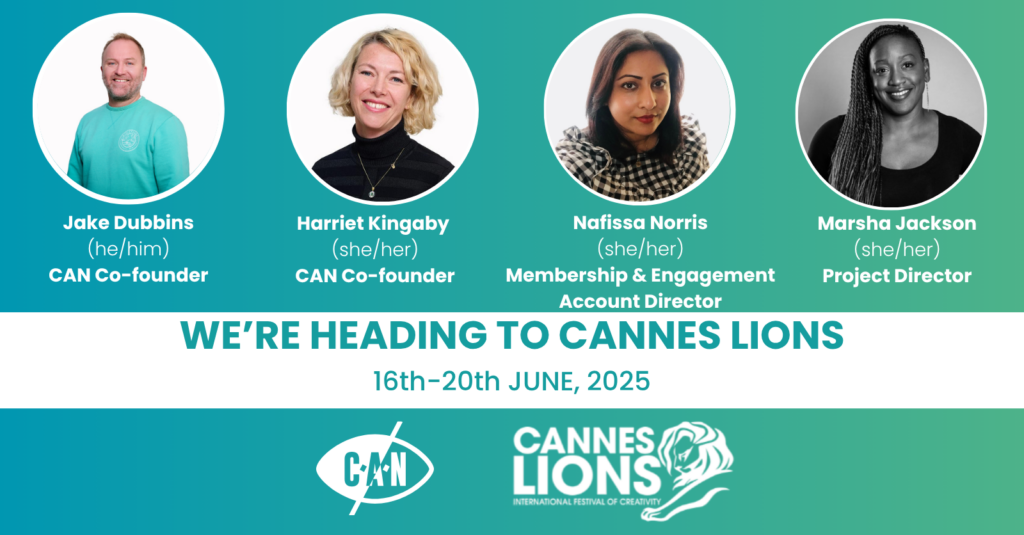
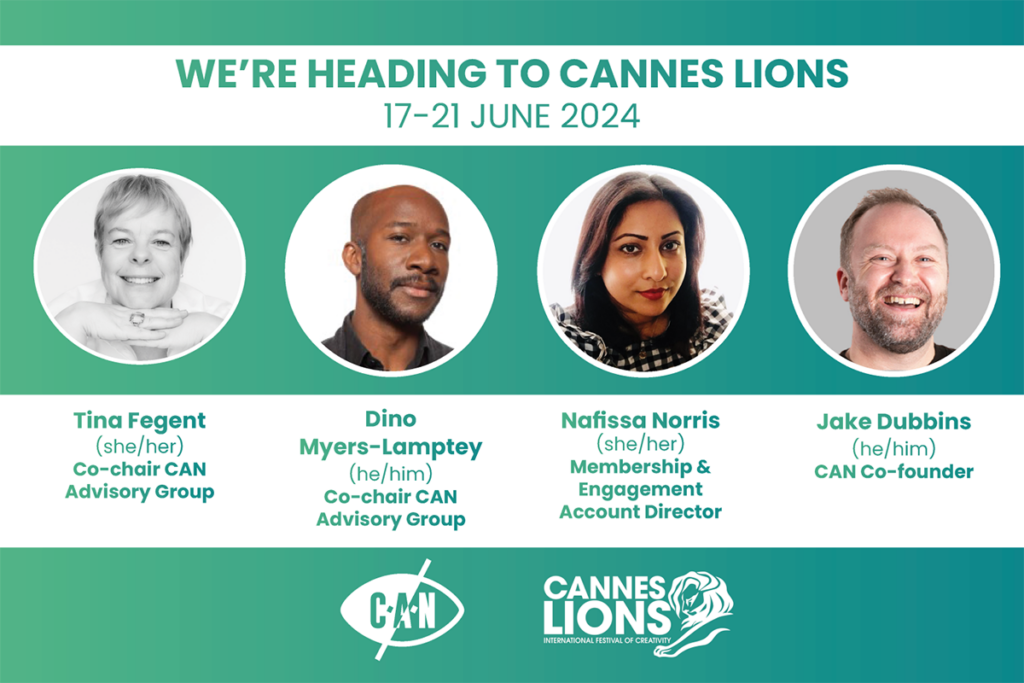
Our 2025 Cannes cohort — including CAN co-founders Jake Dubbins and Harriet Kingaby, alongside Marsha Jackson and Nafissa Norris — engaged in over a dozen panels and high-profile discussions. We covered climate misinformation, inclusive leadership, creator culture, AdTech ethics, and accessibility as a creative advantage. Every moment reaffirmed our belief: advertising can be a force for good — but only if we consciously choose to make it so.
Here’s how it all unfolded…

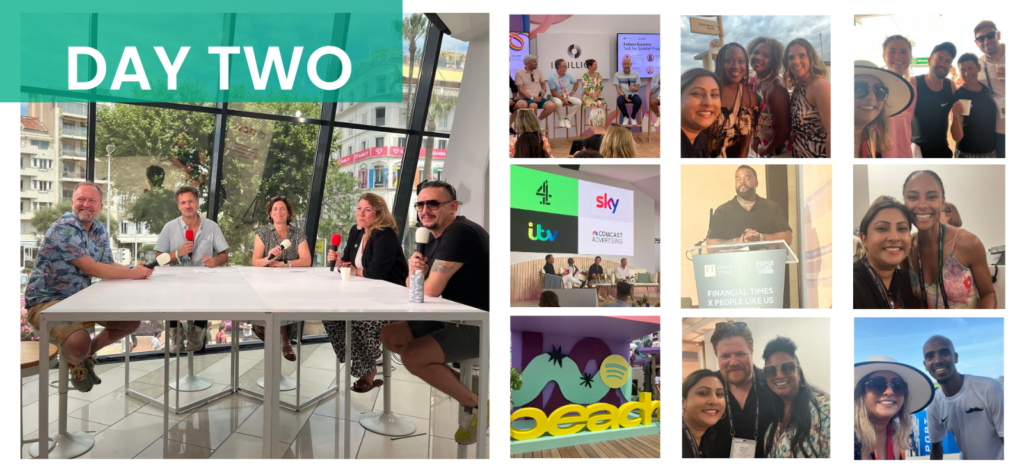
Day One: Conscious Conversations Begin

We hit La Croisette with energy — and a clear intention to challenge and collaborate. 

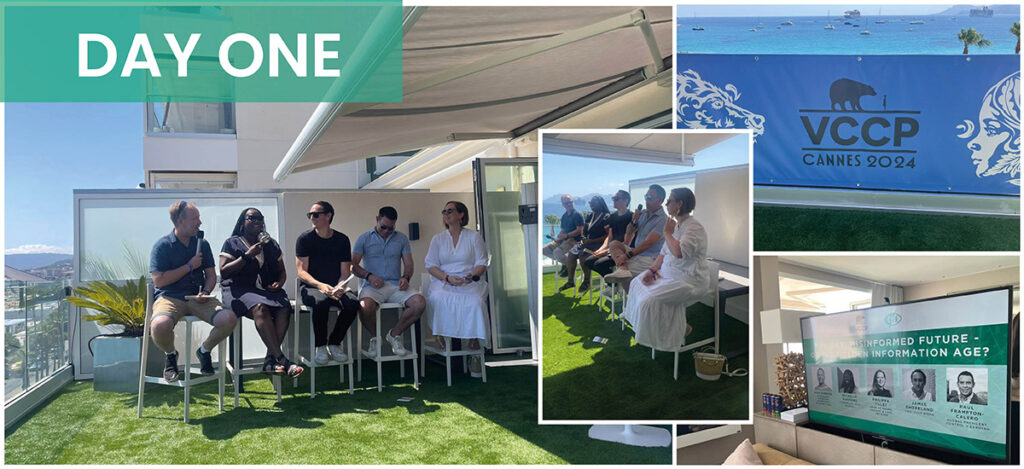
Our first stop: RTL Beach for “The Business of News” with Stagwell and World Media Group, exploring how media companies are redefining journalism to build trust, sustainability, and commercial value. Tackling trust in journalism isn’t just timely — it’s critical.

Later, at the AdTech Lunch hosted by Limelight and The Digital Voice™, we connected with partners to share insights on responsible innovation and how to drive ethical progress across platforms.

There were numerous encounters and lunch meetings with allies and trusted partners, sparking conversations that will carry forward. From happy hour at Empower Café, Ogury’s Exclusive Welcome Soiree, to the first late-night Gutter Bar drop-in — we were officially Cannes-ready.  

Day Two: Accessibility, Accountability, and ACT-ion

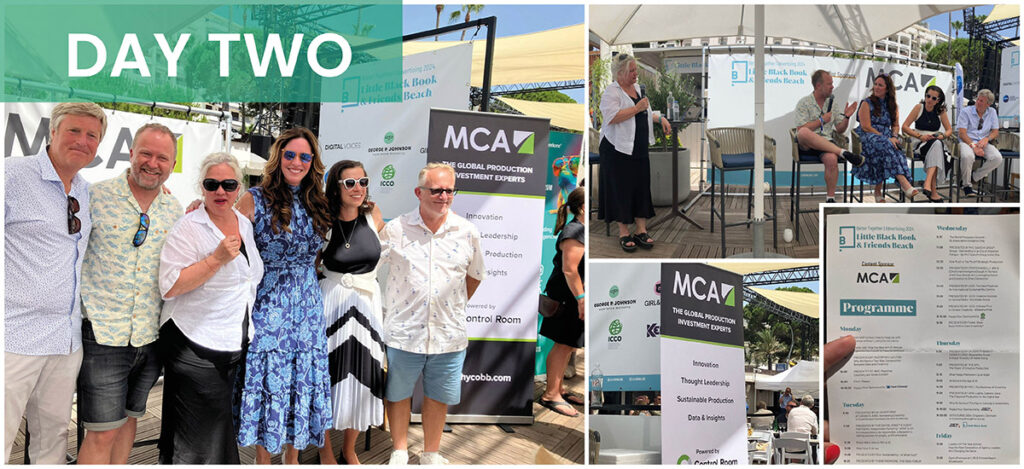
Day two opened with croissants and critical insights at the Ad Accessibility Network’s breakfast — proving once again that accessibility drives not just equity, but creativity. 

Jake Dubbins joined ACT Responsible’s MyACT Show live from the Palais Sustainability Hub, where the conversation zeroed in on one of the most pressing challenges of our time: protecting democracy through creativity. From defending press freedom to promoting civic engagement and digital safety, speakers explored how bold, responsible campaigns can safeguard civic freedoms and rebuild public trust.

Alongside Alexis Ospina (Grey Mexico), Stéphanie Bertrand-Tassilly (Havas), and Charley Stoney (EACA), Jake reflected on how democratic values and information integrity must guide the future of advertising. Catch the replay here.

The Supernova Pride Summit lit up the afternoon with an unapologetic celebration of LGBTQIA+ creativity and leadership — setting the tone for the inclusive conversations to follow later in the week. The event sparked dialogue with inspiring LGBTQIA+ leaders and allies who are using creativity, leadership, and technology to drive a new era of innovation and meaningful inclusion. 

That evening, Nafissa was invited to the Financial Times’ first-ever DEI event at Cannes, hosted in partnership with People Like Us – a standout moment that spotlighted creative leadership, industry change, and the future of inclusive storytelling. This gathering brought together leaders, talent and changemakers to explore how representation fuels creativity and long-term brand value.

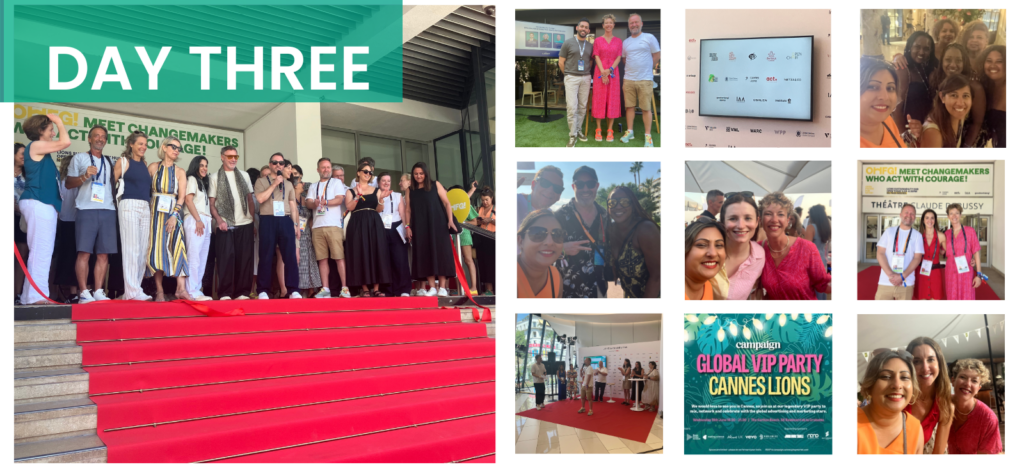
Day Three: Integrity and Impact

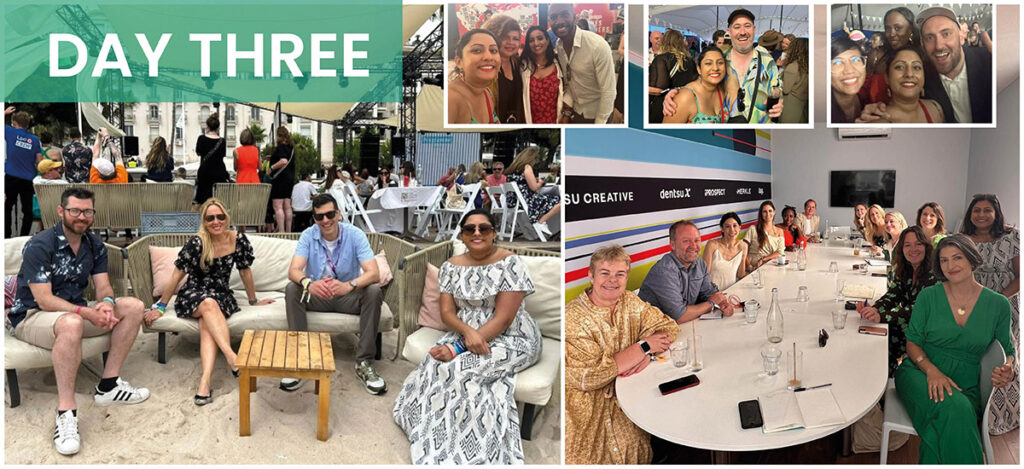
The morning began with Nafissa and Marsha at the Empowerment Café with BIMA’s unflinching panel, “SHIMA: The Big Accusation”, unpacking the devastating role digital ads can play in spreading online toxicity — especially to younger audiences. Creating safer digital spaces starts with honest conversations like this.

At Ogury, Harriet Kingaby and Jake Dubbins joined Samir Chabab to unpack CAN’s “Guiding Principles” — and why ethics and effectiveness must go hand in hand. The message was clear: advertising must be conscious by design. You can access our resource here.

Lunch gatherings and private meetups throughout the day reinforced a shared commitment to information integrity and measurable impact across the ad industry. 

That afternoon, Jake stepped into the Palais’ Sustainability Hub during the “Open House for Good” to deliver a powerful 3-minute pitch — proving again that purpose-led creativity belongs at the heart of business. You can watch it here from 23:19 – 25:55.

The night closed on a high at Campaign’s exclusive VIP party, where the team connected with industry friends old and new — recharging for the final stretch of a landmark week.

Day Four: Culture, Creativity and Collaboration

Day four was all about culture, accountability and bold inclusivity.

It began with Marsha attending a thought-provoking breakfast hosted by Jellyfish x Good Girls, exploring GenAI, culture, and the creative responsibilities shaping tomorrow. As AI reshapes storytelling, inclusive intent must guide the brief.

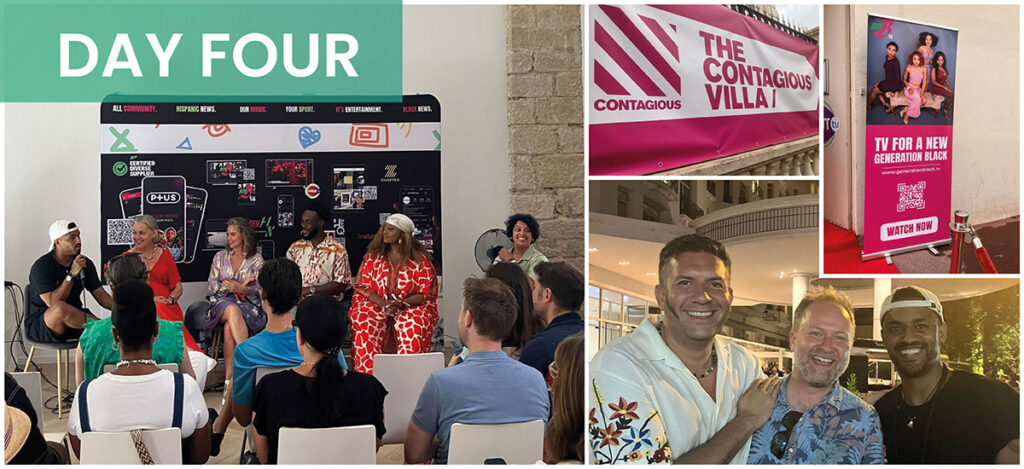
At the Brands&Culture Villa, Harriet Kingaby joined Aisling Conlon, Vanessa Sawyerr, and Sophie Butler to discuss the role of creators in shifting cultural narratives — and how the UK can lead with inclusive influence. 

Later, Nafissa Norris joined Outvertising and Propeller Group to launch The Advocacy Playbook — a practical, high-impact resource guiding advertisers on LGBTQIA+ inclusion. With over $3.7 trillion in LGBTQIA+ global spending power, this isn’t just ethical advertising — it’s effective advertising that works for everyone and makes good business sense. You can access the playbook here.

Day Five: A Milestone Moment on the Forum Stage

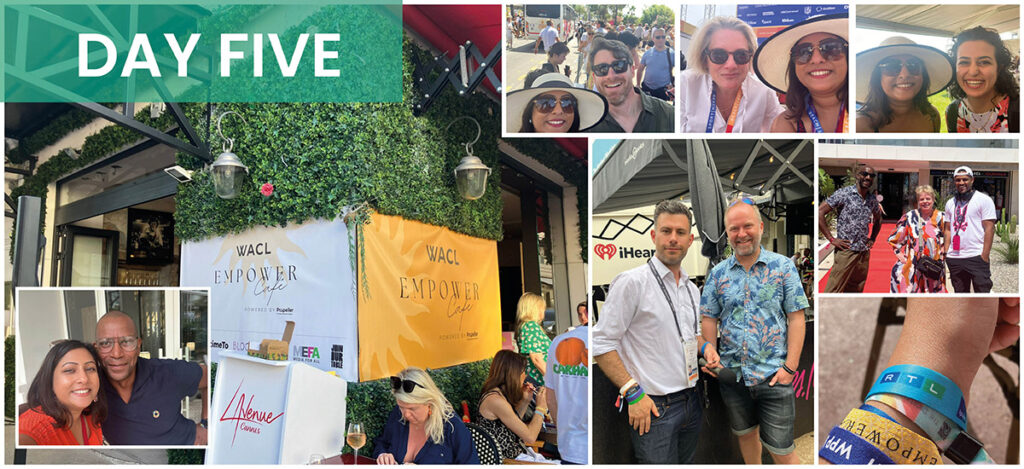
Friday was the milestone we’ve been waiting for — CAN was officially included in the Cannes Lions programme for the first time.

On the Forum Stage, Jake Dubbins joined representatives from the United Nations (Charlotte Scaddan), UNESCO (Tarja Turtia), and the Government of Brazil (João Brant) to present “Climate Information Integrity before COP30”. Together, they launched the Global Initiative for Information Integrity on Climate Change, urging advertisers, platforms, and agencies to align with the UN’s new global principles.

Information integrity is good for business and good for our planet and all its people. By demanding transparency, accountability, and disclosure in the ad tech supply chain, brands can take back control of their ad budgets, support quality journalism and reliable information — and increase advertising effectiveness in the process.

This wasn’t just a panel — it was a turning point. A clear message that conscious advertising is no longer fringe but foundational to the future of the industry. When we change the brief, we change the world… João revealed some big news to end the week: information integrity is officially part of the COP30 Action Agenda for the first time. A historic first — and a powerful step toward Belém, Brazil.

Looking Ahead

Cannes Lions 2025 wasn’t just a showcase — it was a signal. The industry is shifting. Ethical innovation is rising. Conscious creativity is no longer optional. 

We’re returning home recharged, reconnected, and more committed than ever. The conversations we had in Cannes will carry through the year — into COP30, into your campaigns, and into the next chapter of advertising that works for everyone. 

Want to be part of the movement?

Free CAN membership is open now — email us at hello@consciousadnetwork.org to join our free membership.

Here’s to next year — and everything in between.

Until then, from la Croisette… à bientôt.

Introducing the CAN Guiding Principles: Effective advertising that works for everyone. 

We pride ourselves on taking our members’ feedback on board, and their feedback was clear: “We need clarity and simplicity”. In response, we’ve created the CAN Guiding Principles which offer practical steps to help navigate the changes within the advertising industry. Our new resource also provides you with case studies so you can see conscious advertising in action.  

Our aim is to help members achieve commercial success through transparent and responsible advertising – our Guiding Principles are here to help them on that journey.

What are CAN’s Guiding Principles?

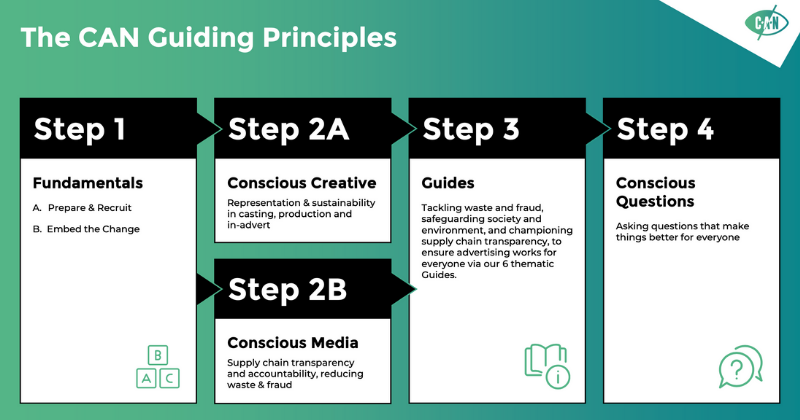
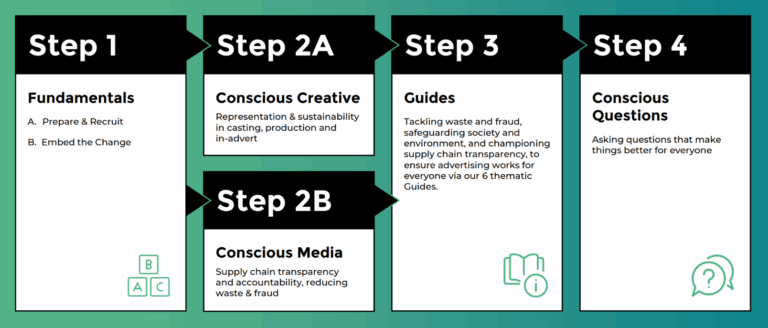
Our 4 Guiding Principles set out a clear base line for members to work from: 

1. Fundamentals: Create organisational change whilst embedding changes through tracking and internal policies.

2a. Conscious Creative: Conscious creative is trustworthy creative that includes, represents and safeguards everyone, including the places we live. It’s the most effective way to ensure your message has mass appeal, and grow the audience for your business.

2b. Conscious Media: Conscious media is effective, privacy conscious and transparently bought media, purchased with safety, quality, sustainability and inclusion in mind. It employs privacy and safety by design.

3. The CAN Guides: Adopt CAN’s six Guides (previously known as CAN’s seven Manifestos) in your agency briefs and Request for Proposals (RFPs)

4. Conscious Questions: CAN is shaping the future of advertising – better tools, policy and enforcement from platforms and adtech providers that mean that efficient advertising doesn’t come at the expense of our rights and freedoms. Adopting a culture of questioning is a big part of improvement. 

If you’re a brand or agency that’s ready to start shaping an advertising industry that works for everyone – join our CAN Membership today by contacting hello@consciousadnetwork.org


The 2024 CAN Annual Report – Our Impact, Your Influence

The CAN Team are proud to announce the 2024 Conscious Advertising Network Annual Report is here. The report reflects on the progress we’ve made and the bold steps we’ve taken to promote information integrity, champion inclusivity, and ensure advertising works for everyone.

What’s Inside:

Hear from Our Co-founders: Gain insights from our visionary leaders and hear about their continued mission to lead the conversation in conscious advertising. 

CAN’s Big Wins: Celebrate the significant milestones and accomplishments that have solidified our influence on the advertising industry over the past year. Learn about the impactful events we have contributed to, campaigns we’ve spearheaded, and new members who’ve joined us.

Member Spotlights: See some of our members’ big achievements of the year through their conscious advertising campaigns, collaborations, and initiatives. See advertising that works for everyone in action.

CAN Spotlights: Our contribution to the UN’s Global Principles, the refreshed Children’s Rights and Wellbeing Guide, working with Propeller Group, and more… 

Membership & Engagement: Learn about the growth in our community and the key highlights from our annual member survey.

What’s to Come in 2025: Get a sneak peek into our plans and initiatives for this year and what to look out for.

To become a member and start working towards effective advertising that works for everyone, contact hello@consciousadnetwork.org  

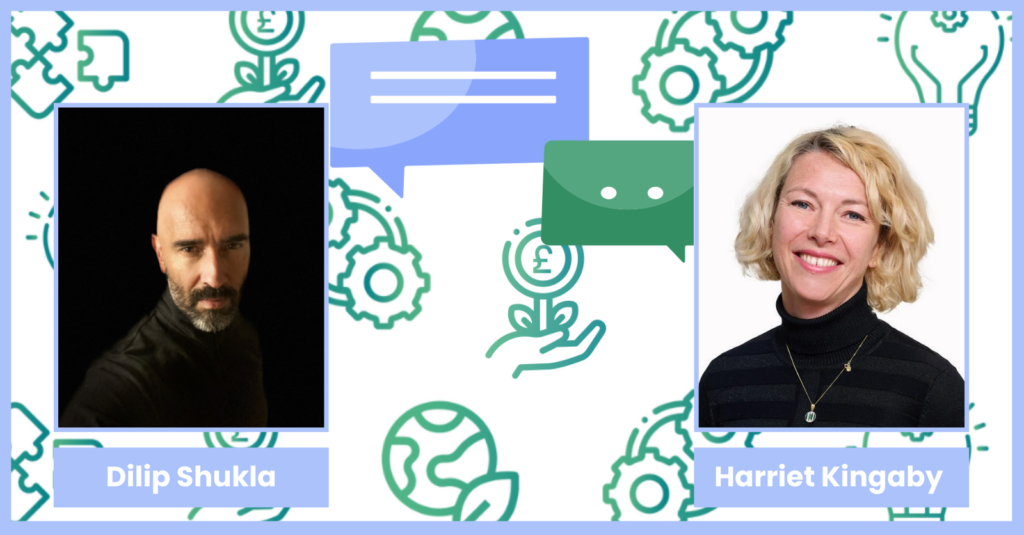
CAN co-founder, Harriet Kingaby and Dilip Shukla of Reset Digital discuss how advertising needs more human understanding and how a results first approach leads to more conscious advertising.

Dilip is an industry veteran from senior media agency roles at WPP, Dentsu and Omnicom also co founding and scaling mediatech startups focused on human understanding for better communication.

Harriet: What’s the most important thing the ad industry can do to be its best self 

Dilip: Recognise that everything we do gets better when we understand human beings better. The industry overestimates its expertise here. The systems and tech our industry uses are based on demographics, sometimes search information, sometimes previous purchases and we measure effectiveness with misleading data. This is a pretty limited understanding of people

Ask yourself this question, do your systems tell you why people do what they do? Human beings do what they do because of their emotions and feelings and the stories they build about their lives. Why does this matter? Results. Reset Digital uses this information to drive great advertising results for brands like Starbucks, Carolina Herrera, Ford, BMW and many more. Better results is what a better industry does.

Harriet: So, more human understanding, does that make our actions as an industry more human? 

Dilip: Well yes, more human understanding does end up driving more conscious advertising choices, they are a natural consequence of the way that better results are achieved. 

Harriet: OK, how do more human systems improve advertising and business results? 

Dilip: When you have data that tells you how a person wants to feel, what their emotions are, their life narratives at any particular moment, then you can understand what kind of communication they are open to. People are complex and dynamic, our industry systems see people as stereotypical and static. This has to change. Reset Digital maps people’s emotions and feelings to place the right ad or brand for that person at that moment. We work with world leading brands and agencies who deploy sophisticated tracking of return on investment and business performance. The result is better results. 

Harriet: And how do these more human methods lead to more conscious advertising choices? 

Dilip: Technology now allows you to understand the detailed human emotions and feelings that attract a person to a specific web page, video, tv programme or influencer. These emotions and feelings tell you which brand or creative execution that person will be most open to at that moment. 

This means that you value well created, meaningful and often in depth content more highly.

It means you don’t spend towards “enrage to engage” type media which is currently way overvalued – because no brands are really in that space.

It means you value the moment rather than taking the data and “buying theaudience” somewhere cheap.

It means you value creative more highly because you can see why it works and for who it works. 

And ultimately it means you can see a business value in understanding people for their unstereotypable complex human identity which will lead to a lot of positive developments in the industry.

Harriet: What sort of positive developments?

Dilip: First of all, better results. But then because those results lead more conscious, responsible behaviours, the industry is more highly valued by advertisers. And then because we treat the people we communicate with more like human beings and they see our more responsible and effective behaviours, they start to upgrade their opinion of the industry. So we try and understand human beings better than we already did. So we start to care more about the people inside our companies. Who can see this happening . . . . because human understanding.

Thank you to Dilip for sharing his invaluable insights with CAN. His perspective on human understanding in advertising highlights a powerful shift – better results come from recognising people’s emotions, not just data points.

If you’re looking to create more conscious and effective advertising, explore CAN’s Manifestos here.


Advertisers have a responsibility to help protect and authentically represent the LGBTQIA+ community. This is why CAN is proud to have partnered with Outvertising to create and launch The Outvertising Advocacy Playbook. 

We’re delighted to introduce this new resource to help advertisers and agencies adjust their approach to future campaigns to support, represent, and reach the LGBTQIA+ community.

Why now?

The LGBTQIA+ market is worth over:
£33 billion in the UK
$1 trillion in the US
$3.7 trillion globally 

According to Kantar and Forbes.

EDI work is associated with higher long-term market performance, and has a consistent positive relationship with higher innovation according to WARC

In the decade since marriage equality was achieved, the UK has fallen from #1 to #16 in the ILGA Europe ranking of countries by legal and political justice for LGBTQIA+ people. It’s more important than ever that advertisers and agencies start to think seriously about how they approach inclusion within their organisations and ads.

“All of us at CAN are delighted to finally be able to share The Advocacy Playbook – a game-changing resource to help advertisers and agencies transform how they approach LGBTQIA+ inclusion. Over the past year, we’ve worked closely with Outvertising to create this comprehensive guide, charged with actionable steps and key takeaways for both advertisers and agencies to help make UK marketing and advertising fully inclusive. With a spending power of $3.7 trillion globally, it’s important advertisers reach and represent the community in the best way. We firmly believe that starting now and being open to change is essential to building lasting LGBTQIA+ equity in our industry.”

Harriet Kingaby, Co-Founder, Conscious Advertising Network

How to start LGBTQIA+ Inclusive Advertising

Real progress takes time, and perfection can’t be expected overnight. This is why The Playbook has been designed to offer step-by-step guidance along with informed data and principles.

To start with, look at LGBTQIA+ equity within your organisation, this includes ensuring: 

✔️ Your LGBTQIA+ colleagues are supported

✔️ All policies and processes are fully inclusive of LGBTQIA+ people

✔️ Employees become more consciously inclusive with training and resources 

✔️ A shadow board and dedicated EDI taskforce are established

✔️ You actively advocate your inclusive values with your partners, peers, clients and competitors 

✔️ Organisation leaders actively champion inclusion activities and publicly support high-profile LGBTQIA+ rights issues

Building LGBTQIA+ inclusion in-house first will stand you in good stead for developing genuine inclusion in your advertising campaigns


About Outvertising

Outvertising is a volunteer-run platform that exists to make UK advertising and marketing completely LGBTQIA+ inclusive. Initiatives include the industry’s leading LGBTQIA+ mentorship programme, a calendar of social events, as well as inclusion training and guidance for brands, agencies and leaders. Existing alongside these resources is the Outvertising community — a network for LGBTQIA+ professionals and allies working in the industry.

“We need to take explicit action now to ensure LGBTQIA+ inclusion isn’t just a buzzword but a systemic part of how we work within the UK advertising industry. The Advocacy Playbook is central to our commitment to building hate-free advertising supply chains by providing advertisers and agencies with clear, actionable steps to make the change we’ve been advocating for. It’s not just about better representation in ads, it’s about reshaping how we think about inclusion at every level of the advertising ecosystem. Only when we’ve all committed to making real, practical changes, will we truly be able to say that there is an inclusive future for adland on the horizon.”

Cassius Naylor, Co-Director of Advocacy, Outvertising

Final thoughts from CAN

The Playbook is an essential resource for agencies and advertisers in the UK. It’s been a pleasure working alongside Outvertising to create such an important piece that we know can make a real difference within the industry. What we need now is for advertisers to absorb the information and implement the changes.

As we head towards the end of another extraordinary and impactful year at CAN, let’s look back at some of our most significant moments from 2024. From welcoming new members, attending some incredible events, and collaborating with the UN – it’s certainly been a year to be proud of.  

New CAN Members

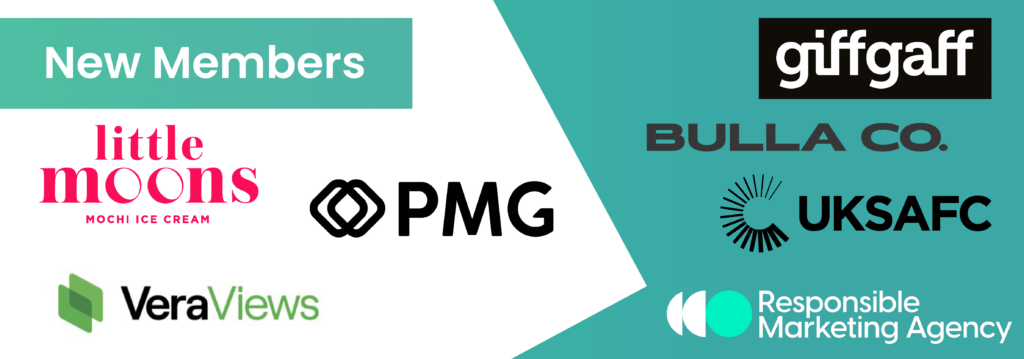
This year we welcomed Little Moons, UK Stop Ad Funded Crime Group (UKSAFC), VeraViews, giffgaff, Responsible Marketing Agency, Bulla Co, and PMG as CAN members.

By joining CAN, they’ve made a commitment to creating a healthier media landscape through conscious advertising, led by our 7 Manifestos. We’re thrilled to have these new members on board and look forward to further collaboration with them over the next year.

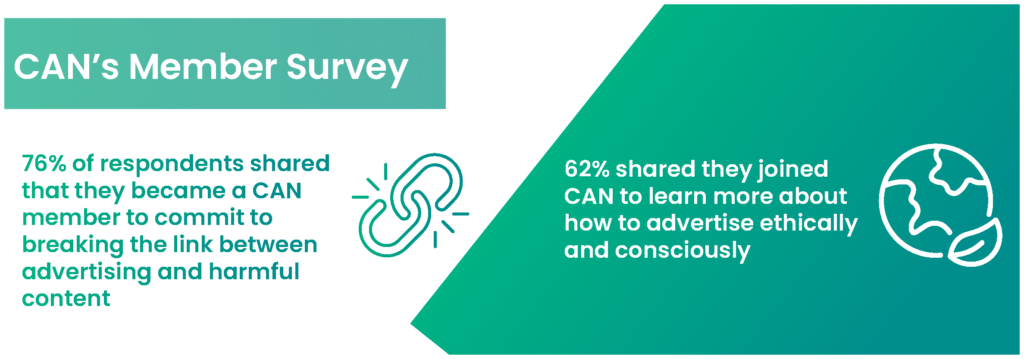
CAN’s Member Survey We had another great response to our annual member survey. Opinions and feedback are a vital part of our membership, so we can prioritise what’s important to our members and further help them make a positive change.

This year’s key takeaways were:

  • 73% gained an understanding of navigating ethical issues in advertising
  • 62% joined CAN to learn more about how to advertise ethically and consciously

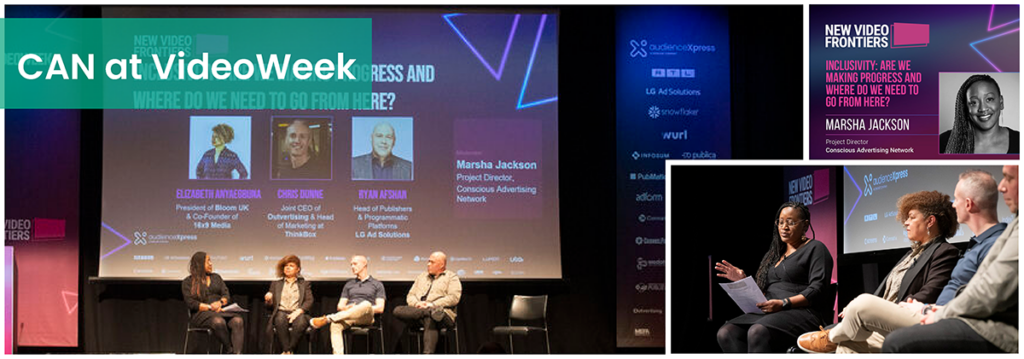
CAN at VideoWeek

We were delighted for Marsha Jackson (CAN’s Project Director) to moderate a discussion at VideoWeek’s New Video Frontiers event which focused on the current state of inclusion across the media and advertising industry. Joining her on the panel was Chris Dunne (Outvertising), Elizabeth Anyaegbuna (16×9 Media), and Ryan Afshar (LG Ad Solutions). The panel explored the importance of viewing inclusion through the lens of intersectionality, and celebrated industry initiatives that are working hard to improve the opportunities for underrepresented talent.

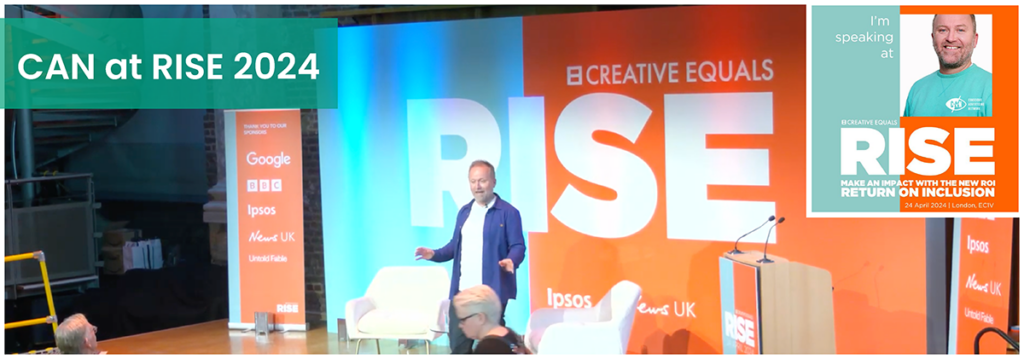
CAN at RISE 2024

CAN attended Creative Equals’ RISE event which covered how to drive inclusion and social impact throughout the marketing chain. CAN co-founder, Jake Dubbins presented an ignite talk on the environmental and social impact of AI’s double edge sword. Jakes thoughts were also featured in Creative Equals RISE Trend Report by Creativebrief (flick to page 30!)

CAN at Advertising Week Europe

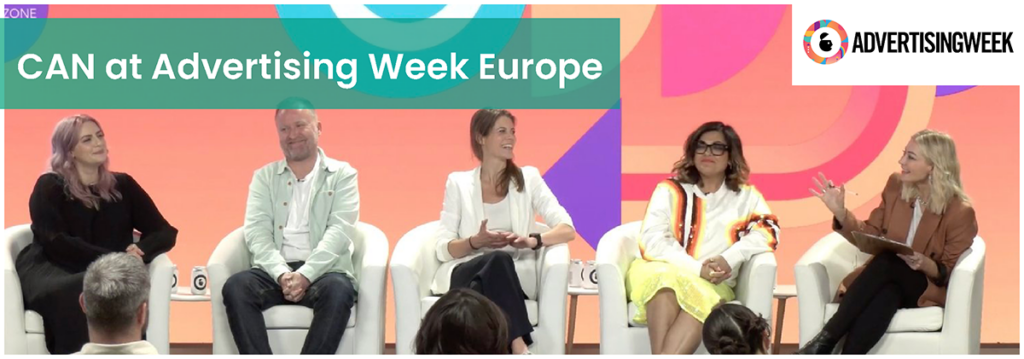
CAN co-founder, Jake Dubbins attended this year’s #AdweekEurope2024 to take part in a panel discussing “Why We Must Stop Advertising-Funded Trolling”. A 2022 UK study found that 36% of people have said they’ve been victims of trolling, the panel explored how the ad industry can ensure it’s not funding hate.

You can learn more about CAN’s guidance on this by reading our Hate Speech manifesto.

The Cost of Confusion Report

We teamed up with CAN member dentsu to create The Cost of Confusion Report which explores the impact climate misinformation has on public perception, corporate trust, and policy support in the UK. Climate communication has been a huge topic for us this year, and we’ll continue to encourage the advertising industry to acknowledge the role they play in combating this issue.

Find out more on our blog piece.

United Nations Global Principles for Information Integrity

CAN was incredibly proud to be part of the consultation process for the UN’s Global Principles for Information Integrity. With the rise in technological advances and the speed at which information can be accessed online, we are seeing an increase in the spread of mis/disinformation and hate speech.

To find out more about the principles and what you can do as an advertiser, head here.

CAN at Cannes Lions

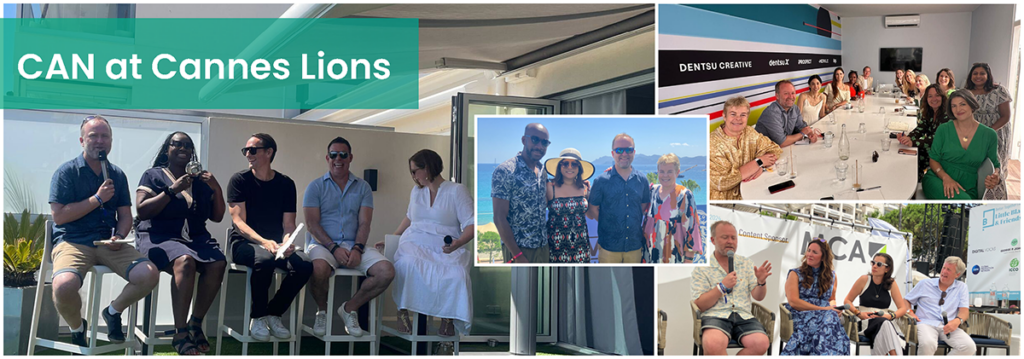
Our Cannes Lions experience was an extraordinary mix of impactful panels, thought-provoking discussions, and meaningful networking, where we highlighted the critical role of conscious advertising in today’s evolving digital landscape. From tackling AI-driven misinformation and climate concerns to building powerful new partnerships, this week reinforced our mission to drive positive change while setting the stage for even bigger waves next year. Explore our Cannes Lions Unpacked blog post to see everything we got up to here.

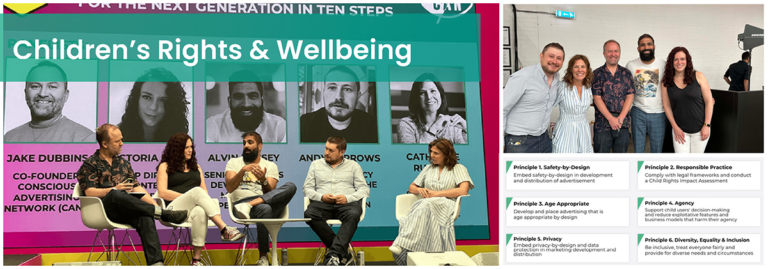
Children’s Rights & Wellbeing Manifesto Relaunch at MAD//Fest

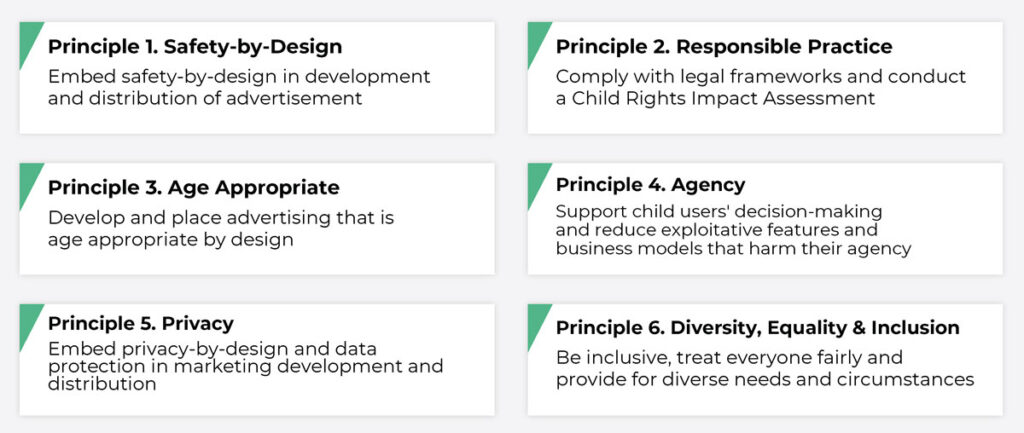
In the summer we relaunched our Children’s Rights & Wellbeing Manifesto to help advertisers prioritise children’s consent, agency, and privacy. Based on 6 guiding principles, the relaunch of the manifesto is here to help protect not only children’s rights, but to protect them from online harms.

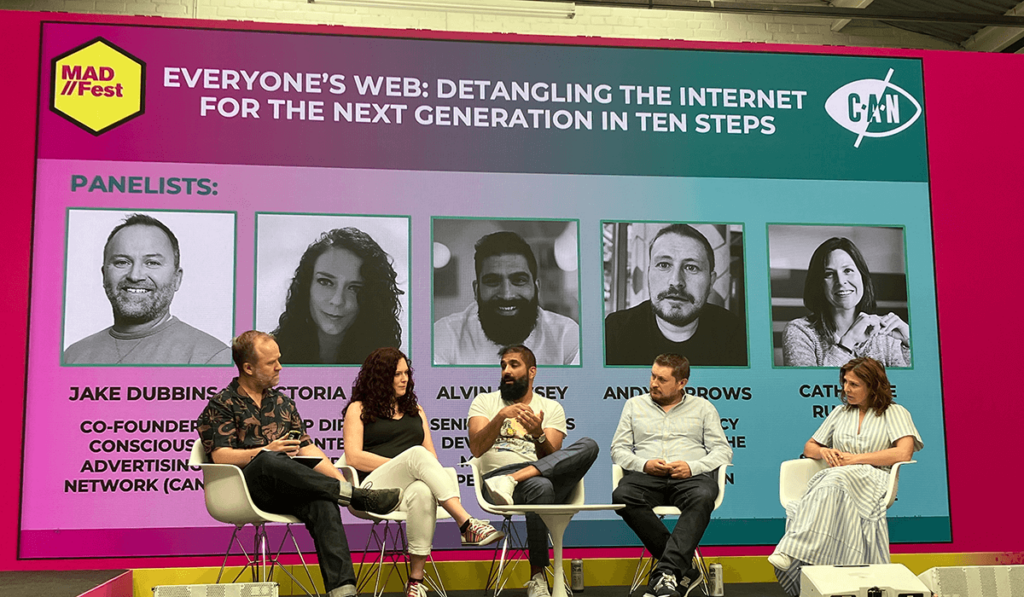
As part of the relaunch, CAN co-founder Jake Dubbins attended MAD//FEST and moderated a panel discussion titled: “Everyone’s Web: detangling the internet for the next generation in ten steps.” The discussion featured current issues for children using the internet and spotlighted industry case studies from Andy Burrows (Molly Rose Foundation), Victoria Ryan (Initiative/LEGO), Alvin Hussey (SuperAwesome), and Catherine Russell (Vodafone). Check out MAD/Fest’s write up here.

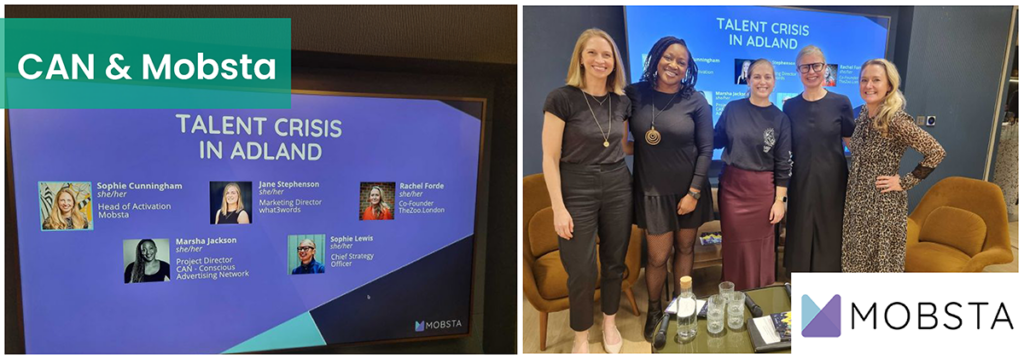
CAN & Mobsta: Talent Crisis in Adland Panel

CAN’s Project Director, Marsha Jackson featured on a panel discussion facilitated by Mobsta. The discussion, titled ‘Talent Crisis in Adland’ was led by the question: “Does the talent crisis in adland require a fundamental shift in agency culture, business models, and talent strategies?” . Marsha was joined by Rachel Forde (TheZoo.London : The Consultant Collective), Jane Stephenson (what3words), and Sophie Lewis (Mobsta Ltd) to discuss the need for a culture shift to address burnout; prioritising mental health; AI upskilling; and creating a more inclusive, flexible, and purpose-driven industry to attract top talent.

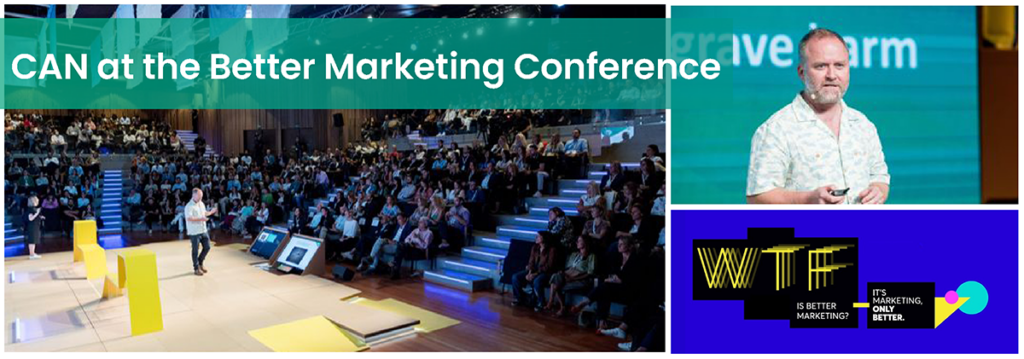
CAN at the Better Marketing Conference

This year was the launch of the first ever Better Marketing Conference in Athens. CAN co-founder, Jake Dubbins spoke about the critical need for transparency in the advertising supply chain, and for CMOs, CFOs and CEOs to wrestle back control of their investment in media. You can watch his keynote speech here.

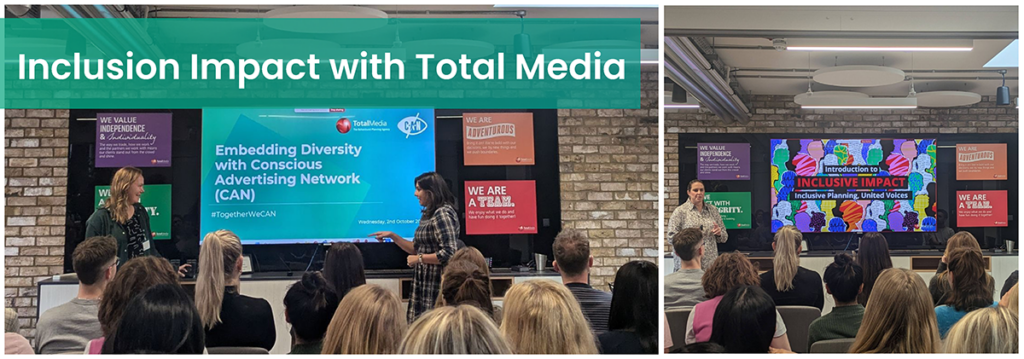
Inclusion Impact with Total Media

Nafisa Norris (CAN’s Membership & Engagement Account Director) and Eline Yara Jeanné (CAN’s Investigations Manager) were delighted to team up with CAN member, Total Media, for their Inclusion Impact initiative which spotlighted the vital role we play in promoting inclusion through advertising. Our talk reinforced the importance of representation in media and how we can collectively create healthier media environments with guidance from our Diversity manifesto. The launch also included breakout sessions from BA Diversity Media Inc and others.

Lunch & Learn with Stagwell

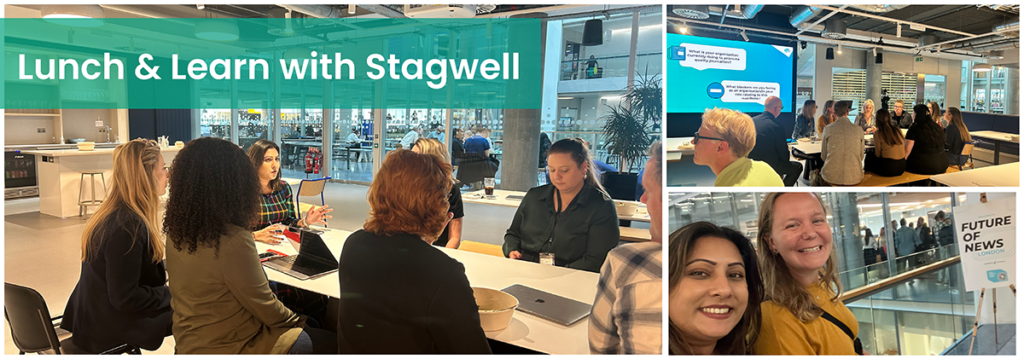
In addition to Total Media’s Inclusion Impact event, Nafissa and Eline were excited to also present at Stagwell’s Lunch & Learn event, where we delivered a session on information integrity. This was a great opportunity for us all to be able to chat openly and candidly in a safe space, which is utterly priceless. After the lunch, Stagwell also hosted their Future of News event, which of course we attended too as supporting partners. The event highlighted the value of news and maximising impact through tailored marketing, along with debuting research on the power of news for UK marketers.

CAN on Climate Change

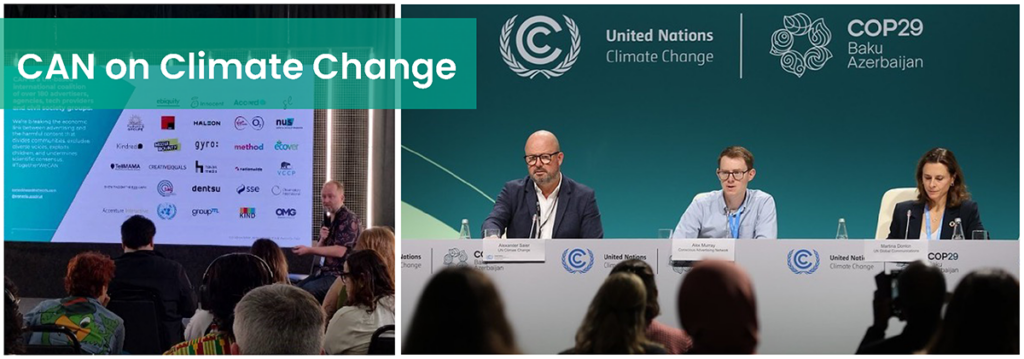
A major focus of our year has been working on projects aimed at protecting the integrity of climate information. To further this goal, we attended three important events: Climate Week, COP29, and the G20 Summit.

All three events were an opportunity for us to raise further awareness of the advertising industry’s role in climate communication and the effect it has not only towards climate change, but to our businesses too. CAN’s Head of Advocacy, Alex Murray attended COP29 and featured on a panel discussion to share his thoughts around this. He also discussed the need for us to understand the systemic incentives and the economic model of attention, scale and opacity often paid for by advertisers.

At the G20 Summit, CAN co-founder Jake Dubbins spoke on stage about the crucial role advertising plays as the economic backbone of our information ecosystems, ahead of the launch of the Global Initiative for Information Integrity on Climate Change. Check out our blog piece here.

CAN at the Responsible Advertising Summit

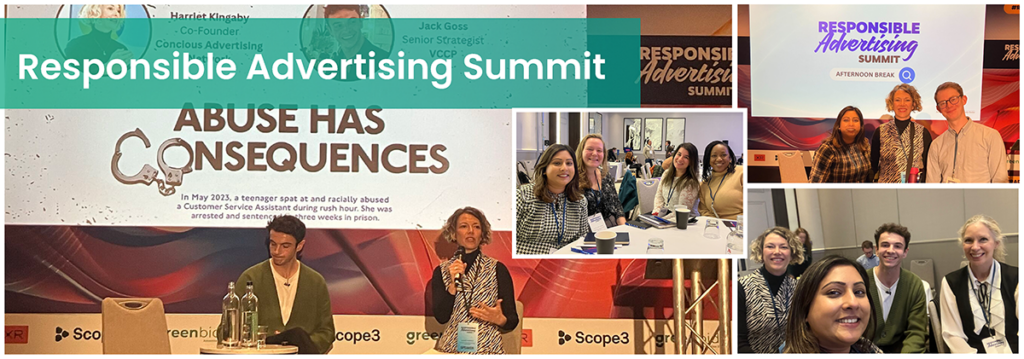
CAN were excited to attend the first ever Responsible Advertising Summit in December, which we were also media partners for. The summit was Europe’s first forum dedicated to elevating standards in sustainable, inclusive & accessible marketing, media and advertising.

CAN co-founder, Harriet Kingaby took part in a compelling fireside chat with Jack Goss Senior Strategist at VCCP. Together they explored ‘The Role for Advertising in Protecting TfL Employees’, based on the ‘Abuse had Consequences’ TfL campaign in partnership with VCCP.

You can download a complimentary report on building the business case for responsible advertising, which CAN co-authored with our friends at the Responsible Marketing Agency here.

We were thrilled to see so many of our CAN members at this 2-day inspiring event and hope to see it run again next year.

That’s a Wrap

Well, that brings us to the close of an incredibly exciting year! Thank you to all the individuals and organisations who have continued to support us, including our amazingly supportive pro bono PR partners Propeller Group! We wish you all a happy holiday season and a consciously creative new year.

#TogetherweCAN

CAN’s Head of Advocacy, Alex Murray attended COP29 in Azerbaijan to highlight the role of climate misinformation as one of the biggest threats to climate action.
“Over the last year we have seen misinformation and disinformation obstructing efforts by authorities during and after extreme weather events in Spain, the US and within the Caribbean. It is critical that this threat to climate action is recognised as an imminent harm and to ensure that the advertising industry has the tools and advice to avoid incentivising for it. CAN will continue to work with the advertising community, climate experts, academics and non-profit organisations to push for information integrity and COP29 represents an important moment for this.”

– Alex Murray, CAN’s Head of Advocacy

The focus for this year’s two-week event was to be set around finance, with discussions around further taxation on profits from fossil fuels, frequent flyer levies, and wealth tax. The event was also primed to debate around how the private sector can help fund the developing world. All with the ultimate goal of keeping global temperature rises under control, aiming for below 1.5°C.
Photo credit: UN Climate Change - Kiara Worth

In the second week of the conference Alex spoke on a panel to discuss misinformation and its threat to climate action. During the conversation he stated: 

“The climate information ecosystem has been compromised by the relentless onslaught of disinformation campaigns orchestrated and amplified by powerful actors… that can be seen nowhere more clearly than in instances of extreme weather, like floods in Brazil and Spain, hurricanes in the U.S. and in the Caribbean, where we’ve seen emergency efforts hampered by disinformation efforts.” 

Watch the panel here

Alex also featured in another panel discussion which focused on Climate Misinformation in Brazil, who will be the host of COP30. Sharing his final thoughts on the conference, Alex said:

“This week we have heard story after story about how disinformation is leading to harassment and threats against scientists, disrupting communications teams and their ability to warn communities about extreme weather events and hampering rescue efforts in the aftermath. The Information Integrity initiative represents a really important start, but we need advertisers to play their role alongside the multi-lateral efforts”

Fighting Misinformation at COP29

With worries over the effect of climate misinformation stalling progress, this was a hot topic at this year’s COP.

As we highlighted through our various member briefings throughout COP29, during the conference, concerns were raised about suspicious social media accounts supposedly from Azerbaijani government leaders and representatives. Posts depicted narratives that Azerbaijan is leading the way for green initiatives. To put this into context, Azerbaijan’s fossil fuels make up 90% of their exports and Ilham Aliyev – Azerbaijan’s President even stated at the opening ceremony that oil and gas are a “gift of god.”

Scientists and campaign groups voiced their concerns at COP29 with an open letter asking governments to take action against social media outlets, advertising technology providers, broadcasters, and publishing companies who enable the spread of misinformation.

The Climate Action Against Disinformation (CAAD) released a report revealing the growing problem of climate change disinformation which is hampering progress towards climate change. The report reveals how Big Tech continues to allow “super-spreaders” to pollute their platforms with debunked claims attacking renewable energy and electric vehicles.

The Global Initiative for Information Integrity on Climate Change

Whilst COP29 was taking place in Azerbaijan, the G20 was occurring in Brazil. There, the Brazilian government, the United Nations and UNESCO launched a groundbreaking Global Initiative for Information Integrity on Climate Change. This is the first time governments are taking action against climate disinformation at the multilateral level and already includes six countries: Chile, Denmark, France, Morocco, the United Kingdom and Sweden.

“This initiative will bring together countries, international organizations, and networks of researchers to support joint efforts to combat disinformation and promote actions in preparation for COP30 in Brazil.”

– President Luiz Inácio Lula da Silva of Brazil

The initiative aims to boost support for urgent climate action at a time when scientists are warning that the world is running out of time. Aiming to expand the scope and breadth of research into climate disinformation and its impacts, the effort will gather evidence from around the world to inform and bolster strategic action, advocacy and communications.

On November 16th, CAN Co-Founder Jake Dubbins was in Rio de Janeiro at the G20 for the launch of the global initiative. Jake spoke on stage about the crucial role advertising plays as the economic backbone of our information ecosystems.

You can watch Jake’s full segment here (from 01:30:56 till 01:37:39)

Final thoughts

The conference ended with an agreement calling on developed countries to deliver $300 billion per year to developing countries by 2035. However, there seems to have been a lot of frustration and concern that this is not enough progress. Developing countries who attended put together a group statement over their disappointment:

“Once again, the countries most responsible for the climate crisis have failed us. We leave Baku without an ambitious climate finance goal, without concrete plans to limit global temperature rise to 1.5°C, and without the comprehensive support desperately needed for adaptation and loss and damage.”

There are also several things that advertisers and agencies can do during crucial climate moments such as COP and beyond. These include:

  1. Ensure you use the CAAD definition to guide you on what kind of content you classify as climate mis/disinformation, and check your inventory for a climate misinformation sites
  2. If you are meeting contacts within tech platforms, ask them about their plans regarding the monetisation of climate mis/disinformation and how they are tackling the problem
  3. Refer to CAN’s sustainability and mis/disinformation manifestos for guidance on how to avoid funding misinformation, and protect the integrity of climate information
  4. Review the recommendations for advertisers within the United Nations Global Principles for Information Integrity (see pages 27-28).

This was certainly an interesting year for COP, we look forward to attending next year and to see what progress has been made.

In the meantime, CAN continue to advocate for sustainable advertising, and to mitigate the risk of misinformation around climate change.

To find out more, head to our manifestos page here.

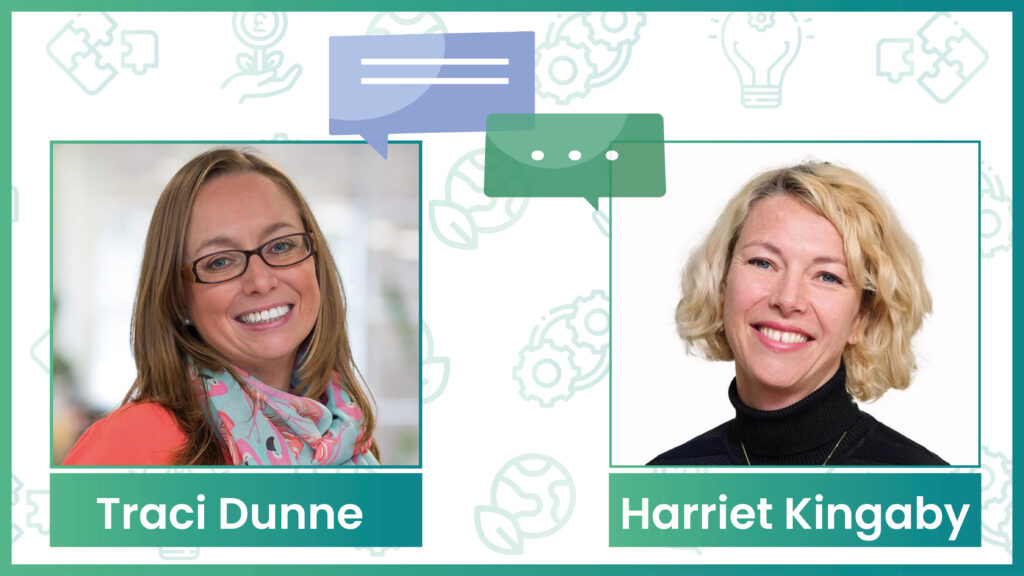
CAN co-founder, Harriet Kingaby has a chat with Traci Dunne who shared her thoughts on Environmental, Social, and Governance (ESG) in advertising organisations. After working in the advertising industry for over 30 years, twenty of which were spent at ISBA, Traci has founded her own ESG consultancy, Transform-Renew-Sustain (TRS).

In the interview we find out what’s motivated her to set up her business, along with the challenges advertisers face. Read on to find out what steps we make now to work towards more conscious and sustainable advertising.

Harriet: What have you set out to do and why is it so needed?

Traci: I could no longer stand by and watch the woeful lack of progress we as an industry are making at an operational level to improve our behaviours across all aspects of ESG.

My business exists tackle the disconnect between corporate ESG commitments set an organisational level and on the ground marketing operations – for both brands and agencies. The fact is corporate targets will simply not be met unless our day-to-day operational processes are structured to support those targets.

Harriet: What are the key struggles for organisations looking to implement large scale sustainability and conscious advertising initiatives?

Traci: The motivation and passion to tackle these areas often exists with pockets of positive activity happening across an organisation. But those activities are often happening in silos and are not cohesively aligned. The reality is that most brand and account teams are time-poor and don’t have the resource or expertise to define a centralised strategy.

There are of course many industry resources available including the fantastic work you do here across the CAN Membership. Your inspirational manifestos provide such a wealth of knowledge and practical advice.

I fear however that many feel overwhelmed at the outset of their journey and defining a strategy can seem like a daunting task. The challenge is often knowing where to start.

Harriet: What should the first step be for businesses looking to make big changes?

Traci: Take the time to read and digest the CAN Manifestos. They provide a genuine roadmap for anyone navigating the ESG space in Advertising and are a must read, in my opinion, for all.

At TRS we always start by carrying out a corporate targets assessment to understand what your, or your client’s organisation is already promising to do, and by when. From there it’s about establishing which of the existing commitments have implications for day-to-day marketing operations, and what processes can be evolved or embedded operationally to support those targets.

Harriet: What are the essentials for success?

Traci: It’s important to set achievable goals, even with the ticking clock of climate change. These efforts are a marathon, not a sprint and it can be easy to get disheartened along the way. Small wins and achievements whilst on the journey can support continued momentum and ensure those doing the work feel like they’re making a difference.

Another key to success is a structured approach to measurement and reporting. As the saying goes: ‘you can’t change what you don’t measure’. Ensuring that there’s a data tracking and reporting methodology to support your strategy is key. This enables you to track your journey, the improvements you’re making, and set a roadmap to meet any specific ESG targets you set for marketing operations. An idea can be to introduce a shared KPI across teams internally that are linked to performance.

Harriet: What are the steps for making change happen?

Traci: Seek out other passionate champions across the business to create a taskforce. Ideally a mix of marketing /account teams, marketing procurement, and a senior leader to enable decision making and keep things moving.

Client/Agency collaboration is key, whoever is in the driving seat. Bring your partners on the journey and ensure they have a voice.

Get help – join or sign up to industry bodies like CAN and get involved.

Attend events or join webinars – you’d be amazed how much you can learn by surrounding yourself with people who live and breathe this stuff. The passion is contagious, you can learn a huge amount and they’re there to help.

Start somewhere!

Harriet: Anything to avoid or be aware of?

Traci: Trying to boil the ocean. It’s very easy to get carried away or overwhelmed once you open the ESG pandora’s box. For many, an immediate reaction is to want to do everything – yesterday. Try to resist this impulse, the fact that you’re doing something is amazing and means you’re already making a difference. You can’t do everything all at once – decide on a set of tasks that you can tackle now and start there.

Harriet: Have you got any examples from your work of best practice? Or cautionary tales?

Traci: A test and learn philosophy can be a good approach to take – nothing is ever perfect, and you can get caught up waiting for endless rounds of approval.

In one case, after 18 months of development with a client, we had to again postpone the launch because of corporate approval hold ups. By the time we were ready to launch, things had moved on and we were already in a position where the work needed updating. This is why a senior, ideally C-Suite champion is so important.

Be brave. No one has ‘mastered’ this, so if you’re in a position to – push the boundaries. Explore what’s possible – be that pioneering brand or agency that others aspire to be.

Thank you to Traci for taking the time to chat with CAN and sharing her invaluable insights. You can reach Traci via email here

If you’re making the first steps to building ESG into your organisation, don’t forget to read through CAN’s Manifestos here.

With the rise in technological advances and the speed at which information can be accessed online, we are seeing an increase in the spread of mis/disinformation and hate speech. We have seen all too clearly over the last month in the UK and across the globe how serious the implications of this can be. To fix this, we need to work together across the advertising and media industry.

In June, the United Nations launched its Global Principles for Information Integrity in response to the problem. At the launch, United Nations Secretary-General António Guterres stated:

“At a time when billions of people are exposed to false narratives, distortions and lies, these principles lay out a clear path forward, firmly rooted in human rights, including the rights to freedom of expression and opinion.”
The Conscious Advertising Network (CAN) was one of the leading advisors for the UN. We advocate for the entire advertising and media industry to act now and start adopting these principles where they can.

The Five Global Principles

The UN is calling for governments, tech companies, advertisers, media and other stakeholders to take action and help address this global threat by following these five principles:

  1. Societal Trust and Resilience 
  2. Healthy Incentives 
  3. Public Empowerment 
  4. Independent, Free, and Pluralistic Media 
  5. Transparency and Research

Why We Need to Act

Whilst targeted advertising and content monetisation have been acknowledged to have opened up opportunities for businesses worldwide, it cannot be ignored that they have also had a negative impact. 

The current digital advertising process lacks transparency and can incentivise disinformation and hate by exploiting user behaviour data to maximise engagement and revenue. This makes it possible for
advertisers to inadvertently fund undesirable individuals, entities, or ideas. This poses a risk to both brand safety and the effectiveness of advertising campaigns. 

Advertisers – What You Can Do

The guidance has set out recommendations for stakeholders across the information ecosystem. Here is a summary of what they have recommended for advertisers:

Establish human rights-responsible advertising: Establish safeguards, avoid discriminatory targeting practices, and advertise with media outlets that bolster information integrity.

Harness industry standards: Make use of industry standards to develop clear policies to minimise risks to information integrity and help ensure brand safety.   

Form coalitions: Collaborate across industry and civil society to assess the impacts of advertising, and systematic mitigation of risks and potential harms from advertising and content monetisation. 

Require data: Establish an ongoing and full overview of advert adjacency, conduct suitability reviews before advert placement, and carry out thorough audits of advertising campaigns. 

Obligate transparency:Require ad tech companies to adopt transparency standards and share full advertising campaign data with clients and researchers, including placement and blocking data at the log level.  

Undertake audits: Require ad tech companies to carry out independent third-party audits and vetting of ad exchange supply partners.  

As advertisers and ad agencies, it is imperative that we start to take action within and work together to help make a successful and long-term change.

Head here for the full guidance.

A note from our Co Chairs

“The United Nations Global Principles for Information Integrity are a huge step forward in the fight against misinformation and hate speech. We are delighted to have played an important role in fostering, through the Global Principles, a trustworthy advertising landscape, which will directly contribute to the overall integrity of the information environment”

– Jake Dubbins and Harriet Kingaby.

At CAN, we combine our advertising and human rights expertise to help implement industry, platform, and policy interventions – and embed human rights within relevant commercial and political decision-making, globally. To find out more about us and how to become a member, head here.

In the past week, we have seen riots take place across the UK, and people of colour targeted by far-right groups in the streets. This violence has been fuelled by misinformation online, which has been loaded with hate speech and xenophobia. This deeply concerns us at CAN, and will have been personally frightening for many of you, as it was for many of our team.

CAN’s mission is more critical than ever. We exist to try and break the economic link between advertising and the harmful content that divides communities. The choices we make as advertisers significantly impact society. Our industry can and should be doing better.

As we state in our mis/disinformation manifesto:

“Advertising can support the fight against disinformation and misinformation by funding reputable, high-quality, and publicly accountable publishers and broadcasters; taking swift action against publishers who peddle inaccuracies for commercial gain; and supporting public education around critical evaluation of media content quality and trustworthiness.

Advertisers should also take action to ensure that they do not inadvertently fund disinformation. The suppression of viable and accurate information is a form of misinformation in its own way.”

What CAN is doing:

  • We are ready to engage with the new government and OFCOM to urgently review the Online Safety Act which, while important, took too long and is woefully inadequate to deal with this level of disinformation and hate fomented on and offline.
  • We are in touch with our civil society partners and supporting or advising them where appropriate.
  • CAN will continue to engage with the UN on its United Global Principles for Information Integrity, which our advice helped to create. The United Global Principles for Information Integrity highlight how technological advances have enabled the spread of misinformation, disinformation and hate speech at an unprecedented volume, velocity and virality, risking the integrity of the information ecosystem. 

What YOU can do:

  • Review your organisations’ misinformation policy and ensure it is being met currently. Audit your site and app site lists to check they are not inadvertently funding hate or misinformation.
  • Check in with team members from global majority backgrounds to offer support during these challenging times. Organisations such as NABS are dedicated to advancing the mental wellness of the advertising, marketing and media community and are offering support through an advice line and coach-facilitated discussions
  • Review your keyword block list to be certain you are not defunding high-quality journalism covering large scale news events or covering misinformation itself.
  • Ask your platform representatives what they are doing to ensure your brand safety and information integrity around these issues, and what steps they are taking to ensure this doesn’t happen again.
  • Refer to CAN’s manifestos and the guidance within them and get in touch with the CAN team with any questions.

A message from CAN co-founders & co-chairs Harriet Kingaby & Jake Dubbins:

At CAN, we are an inclusive group, set up to improve the whole advertising industry. We strive to be inclusive of all and to address issues of extremism and marginalisation and look forward to continuing this work with the CAN membership. If you have further questions on this, or would like a chat, do get in touch by contacting Nafissa Norris, our Membership & Engagement Account Director. We will keep CAN members updated on any further developments.

We thank you once again for your support of CAN and hope that you and your loved ones are safe.

With the relaunch of our Children’s Rights and Wellbeing manifesto, we are spotlighting case studies from the industry highlighting how some of the principles outlined in our manifesto can be applied in practice. Our first case study comes from SuperAwesome – an award-winning technology company that is paving the way for responsible digital advertising to under-18s. 

SuperAwesome is an award-winning technology company that is revolutionising how we advertise to under-18s. Through the launch of AwesomeAds in 2013, they have created a platform that engages with younger audiences in a compliant and safe environment. Their work with gaming integrations, YouTube channels, influencers, and digital media professionals has paved the way for responsible digital advertising that puts children’s wellbeing at the forefront.

This case study illustrates how to embed safety-by-design in your advertising products, and how to market in an age appropriate manner; things which are outlined under Principle 1 and 3 in our Children’s Rights and Wellbeing manifesto.  

Read the full case study here.

We are excited to have relaunched our Children’s Rights and Wellbeing manifesto.
 
Last year, we started the process of reviewing and updating this manifesto. The process behind this new and improved manifesto has included roundtables and workshops with experts in the field, working with both civil society partners as well as advertisers and agencies. We have been honoured to work with groups such as Omnicom Media Group UK, NSPCC, the 5Rights Foundation, and Barnardo’s, as well as various academics, experts, and campaigners. This has helped us ensure that the advice contained within the manifesto reflects leading global actionable advice for advertisers.
 
We believe it is essential that advertisers understand their role in taking accountability for children’s safety online.
The manifesto contains six principles to help guide brands and advertisers to navigate this:
 
  1. Safety-by-Design: Embed safety-by-design in development and distribution of advertisement
  2. Responsible Practice: Comply with legal frameworks and conduct a Child Rights Impact Assessment
  3. Age Appropriate: Develop and place advertising that is age appropriate by design
  4. Agency: Support child users’ decision-making and reduce exploitative features and business models that harm their agency
  5. Privacy: Embed privacy-by-design and data protection in marketing development and distribution
  6. Diversity, Equality & Inclusion: Be inclusive, treat everyone fairly and provide for diverse needs and circumstances

Unlike legal frameworks, this document sets aspirations for organisations to work towards. When working with members, we support them on their journey towards conscious advertising rather than expecting immediate perfection.

Rani Govender, Policy and Regulatory Manager at NSPCC, said of the new manifesto:

“Advertisers have a crucial role to play in delivering positive experiences for children online. Through tailoring their decisions to children’s rights and needs and by prioritising brand safety, they can help create a safer online world for children.

The NSPCC welcomes the updated Children’s Wellbeing Manifesto. Its ambitious, child-centred framework will support advertisers to consistently consider children’s needs and embed practices that promote their safety and wellbeing. We look forward to seeing advertisers use the Manifesto to make positive changes for children and demonstrate their commitment to a safer online world.

Yeo Joung Suh, CAN’s Policy and Campaigns Officer (Children’s Wellbeing) shared:

“I am very grateful to have completed the manifesto review. My sincere thanks go to all the individuals and organisations whose tremendous help made this possible. I had the privilege of meeting about 40 experts from various companies and organisations, and their insights provided a significant and invaluable learning experience.

The relaunch of the manifesto is just the beginning. Our goal is to ensure it is effectively utilised within the industry. We’ve updated it based on stakeholder feedback, but its value depends on active industry use. We are committed to promoting and ensuring the effective use of it within the advertising industry.”

CAN panel at MAD//Fest, with Jake Dubbins, Victoria Ryan, Alvin Hussey, Andy Burrows, and Catherine Russell

We were excited to announce the relaunch of the Children’s Rights and Wellbeing manifesto at MAD//Fest this year, where we hosted a panel titled “Everyone’s Web: detangling the internet for the next generation in ten steps.” CAN Co-Founder Jake Dubbins moderated the panel, and we were honoured to be joined by Andy Burrows (Public Policy Strategist – Molly Rose Foundation), Victoria Ryan (Content Partnerships Director at Initiative – on behalf of LEGO), Alvin Hussey (Senior Business Development Manager – SuperAwesome) and Catherine Russell (Head of Sustainable Business – Vodafone).

The panel focussed on highlighting the current issues for children using the internet, spotlighting industry case studies, and the urgency and importance of advertisers’ responsibility. The need for safety by design was a key takeaway from the panel, with Andy commenting: “We are talking about preventable harm. We need to get to a point where safety is baked in by design; where it’s not an afterthought.”

During the panel, Jake led a Deep Dive highlighting key elements of our Children’s Rights and Wellbeing manifesto and shared a checklist of actions for advertisers and agencies to take to ensure they are protecting children online. He closed with the powerful words: “It’s vital we join forces. Take this personally. These are our children, our families, our communities.”

Read our refreshed Children’s Rights and Wellbeing manifesto here.

The Anticipation

In the weeks leading up to Cannes Lions International Festival of Creativity, our team was buzzing with excitement. We meticulously planned our schedule, eager to dive into the festival’s rich array of sessions and networking opportunities with our members. We sought event recommendations from our network and Cannes Lions experts, Propeller Group, our amazing pro bono PR partner. Excited to engage with industry leaders and innovators, we embarked on our 16-hour rail trip…

Aims and Achievements

From the outset, our primary goals were clear: Networking and Door Opening. Cannes Lions provided the perfect platform to condense months of networking into five intense days. We seized every opportunity to build relationships with both existing and prospective members along with allies, forging partnerships that will strengthen our mission in the months and years ahead. 

The CAN at Cannes team included CAN co-founder Jake Dubbins, CAN advisory group co-chairs Tina Fegent (FCIPS) & Dino Myers-Lamptey, and CAN Membership & Engagement Account Director Nafissa Norris.

Raising CAN’s profile at Cannes Lions was another key objective. The festival of creativity offered a unique stage to raise awareness of our work and showcase our expertise to an audience of industry leaders and potential partners. Through panels, roundtables, and informal discussions, we highlighted the critical importance of conscious advertising and the enforcement of platform policies, positioning these not just as moral imperatives but as essential components of commercial success.

Day One: Setting the Stage

Our debut at Cannes Lions was marked by a compelling panel co-hosted by CAN and VCCP, and expertly moderated by CAN co-founder Jake Dubbins who wasn’t shy of asking the difficult questions. Titled ‘a murky, misinformed future – or the golden information age? VCCP & CAN explore how future technologies can be harnessed for good’, the discussions delved into the dual-edged sword of AI in advertising—its creative potential and the risks of misinformation. We also tackled the waste in the programmatic supply chain and the monopolistic grip of major tech platforms on advertising. The conversation on climate misinformation, spurred by our “Cost of Confusion” report with dentsu, was especially poignant. Here are some stand-out quotes:

Jake Dubbins (Co-founder of Conscious Advertising Network): “Sir Martin Sorrell earlier today on a panel said that AI will create millions of personalised iterations of an ad – the implication being that this is somehow a good thing. I think that’s a bad thing. The climate footprint and also just the consumer facing clutter is overwhelming in that vision.

Michelle Sarpong (Commercial lead at the7stars):“Clients don’t care about carbon calculators, but they do about cost impact”

James Shoreland (CEO at VCCP Media): “Strategy is just as much about you don’t do and what you do, do… you want more impact for less effort”

Paul Frampton-Calero (Global President and CEO at CvE – Marketing Consultancy):“If AI is used well, it can start to identify where the bad actors are”

Philippa Tilley (Head of Brand, Radiant & Care at Unilever): “Is my brand getting into a space where my brand should not be? We used to know the media we were buying … and we don’t have that anymore… Which is now terrifying”

A collage of the Conscious Advertising Network team at Cannes Lions

Day 2: Provocative Dialogues

CAN co-founder Jake Dubbins took on tough questions about the cost of sustainability at the LBBonline – Little Black Book & Friends Beach. Industry leaders like Mindy Barry from Mars and John Osborn from Ad Net Zero shared their insights on sustainable consumer engagement and the fight against greenwashing. Anastasia Leng from CreativeX underscored the importance of reusing creative work, pointing out that over half of produced content never reaches consumers. Jake passionately highlighted the overlooked sustainability concerns at Cannes, especially the environmental impact of AI-driven personalised ads.

Day 3: Continuing the Conversation

The discussions around ad fraud and brand safety continued with UKSAFC members and our own Membership & Engagement Account Director, Nafissa Norris. The collaboration and commitment to best practices in advertising were evident as we planned further joint efforts post-Cannes Lions. In addition, a private roundtable hosted by dentsu’s Jessica Tamsedge and Jordan Hunter-Powell in partnership with CAN enabled candid conversations about creating impactful advertising without harmful outcomes, promising quarterly follow-ups to keep the momentum. Special thanks to Gail Gallie for expertly moderating, and to special guests MelRose Wild (Bickerstaff), Julia Linehan, Linn Frost, Amy Williams, Sase Aimiuwu, Amy Bryson, and Tia McPhee. Our day concluded with the infamous Campaign UK party!

Day 4: Diversity and Celebration

Supporting our members at vibrant events like the BA Diversity Media Inc Riviera Rainbow Brunch, where we engaged in crucial conversations about diversity in media and advertising – including a spotlight on GenBTV – Generation Black TV. The WARC Riviera Reception at the Contagious villa was another highlight, providing a relaxed atmosphere to connect with industry peers while enjoying men’s Euros football, resulting in England 1 –1 Denmark. However, despite maintaining our professionalism all day, we couldn’t resist the must-visit experience of the infamous Gutter Bar!

Day 5: Engaging with Members

Our journey wouldn’t be complete without a series of meaningful meetings with our members. These intimate gatherings were a testament to the dedication and passion within our network for driving positive change in advertising. Discussions covered practical strategies, boosting membership collaboration, and added humour on navigating this intense week of networking and theatrics. After all, when else would you have a meeting while seeing the Olympic flame go by?

Reflections and Moving Forward

As we journeyed home for 16 hours via rail, the echoes of Cannes Lions lingered—a testament to the power of collective action and dialogue. The festival renewed our commitment to conscious advertising and ignited our determination to drive industry change.

Looking ahead, we’re energised by new partnerships and commitments, many of which were formed with The Marketing Society, Goals House, Clean Creations, Stagwell and others. This experience is not an endpoint but a catalyst for ongoing advocacy and collaboration. Whilst the topic of AI was on the forefront and sustainability on the backfoot, there’s food for thought on how CAN could make bigger waves in Cannes next year. In fact, we hit the ground running as soon as we got back on Monday 24th June with the release of the United Nations Global Principles on Information Integrity, of which CAN were leading advisors on this framework to enhance digital safety worldwide, read it here.

In a statement, co-chairs of CAN, Harriet Kingaby and Jake Dubbins, called the framework “a huge step forward in the fight against misinformation and hate speech”.

Thank you to everyone who contributed to making our Cannes Lions experience unforgettable.

Here’s to the future of ethical advertising and the transformative impact we strive to achieve.

Until next year, le Croissette!

      • Widespread Concern: The majority of Britons believe climate change is affecting the global and UK economies, as well as the cost of living.

      • Impacts Underestimated: Despite widespread concern, many underestimate the personal impacts of climate change on their own health and quality of life.

      • Only 9% trust brands all of the time to accurately communicate climate commitments 

      • 85% recognise that humans have impacted climate change, but only half (50%) understand that humans are the main cause of climate change

      • Social Media’s Role: 40% of respondents identify social media as the primary source of climate disinformation.

    Climate disinformation prevalent in the UK


    Overall, 82% of the British public believes in at least one of the pieces of disinformation presented in the survey, and the average British person believes in 2.4 of the 7 pieces of information. Men, millennials and those outside England believe in more of the pieces of disinformation on average. Despite this, most (55%) do understand that climate disinformation has contributed to confusion or scepticism about climate change. A full 40% of respondents pointed to social media as the primary source of climate disinformation, followed by news articles (20%) and family and friends (9%).

    Concern about impact disconnected from the personal


    There is a high level of public concern about the impacts of climate change on various aspects of life. Two thirds (66%) believe climate change affects human health, but only 41% believe it affects their personal health. Further, while 74% believe climate change affects food and water security, only 48% believe it affects their quality of life, emphasising the need to connect global issues to personal experiences.

    Impact on brands


    With a high concern over impacts on the UK and global standard of living, 45% of consumers would stop supporting a company associated with climate disinformation while only 9% fully trust brands in how they portray their climate commitments. The prevalence of these narratives and mixed understanding of impact poses a risk for British businesses. Ultimately the report highlights the urgent need for targeted interventions which counter climate disinformation and promote accurate information to those susceptible to it.


    Jake Dubbins, co-founder, Conscious Advertising Network said: 

    This research shows that misconceptions about climate change are widespread, and the advertising and media industries must recognize their role in either perpetuating or addressing these misconceptions.Businesses need to recognise that association with climate disinformation not only undermines their credibility and reputation but also jeopardises their long-term viability in a world increasingly focused on sustainability. By actively distancing themselves from disinformation and ensuring messaging aligns with climate science, companies can contribute to a more informed public discourse, bolster consumer trust, and safeguard their future in a changing economic and environmental landscape.CAN is working with media owners and tech platforms alongside members to implement climate misinformation policies aligned to the Conscious Advertising Network Climate & Sustainability manifesto. This has helped lead to climate misinformation policies developed by Google, Pinterest, Meta and Tik Tok”


    Pamela Stathaki, Head of Sustainability for the UK and EMEA at dentsu said: 

    “This survey shows us that there’s clearly a disconnect between the understanding of the global and personal impact of climate change and we’re hoping our work here can contribute to a greater sense of corporate responsibility. Therefore, when it comes to climate crisis communication – there is a need to create a responsible, evidence-informed dialogue which resonates with people. This demonstrates more than ever the power of industry bodies like CAN to convene key players across the industry including the platforms to both recognise the harms of mis/dis info and uphold standards.”


    To learn more, download the report here.